Monday, August 5, 2013

State-By-State: Kentucky


1938 Camp Map for Kentucky
If you are looking for detailed information on the work of the CCC in Kentucky, you’re really in luck because there is at least one book devoted to CCC work in that state.  Kentucky’s Civilian Conservation Corps by Connie M. Huddleston will be a boon to anyone researching Kentucky’s CCC work; the photos and illustrations alone make it a real treasure.  I am especially drawn to Huddleston’s text and photos related to the work of the CCC at Cumberland Falls State Park.  A few years ago, the annual Civilian Conservation Corps reunion was held at Cumberland Falls State Park so in the case of Kentucky, I have some photos of my own to share.  To access an article about the reunion that I posted at the Forest Army blog back in 2007, click here.

Huddleston notes that the first CCC camps established in Kentucky were those at Cumberland Falls and Mammoth Cave and that by October 1935 a total of 35 camps had been opened in the Bluegrass State.  More to the point, Perry Merrill provides a snapshot of camp totals in his book Roosevelt’s Forest Army.  According to Merrill, there were 44 CCC camps in Kentucky in June 1937.  This total is likely taken from the annual reports published by the U.S. Government Printing Office in Washington, D.C.  The Annual Report of the Director of Emergency Conservation Work for fiscal year ended June 30 1937 gives the breakdown of camps by types in Kentucky exactly as reported by Merrill, specifically:
CCC-built bench and steps, Cumberland Falls, KY
National Forest Camp: 8
State Forest Camps: 1
Private Forest Camps: 8
Agricultural Engineering Camps: 2
Soil Conservation Camps: 14
National Parks Camps: 4
State Park Camps: 6
Military Reservation Camps: 1

The total monthly enrolled strength for enrollees entering the CCC from Kentucky in fiscal year 1937 was reported as follows:

July 1936:  11,272
August 1936:  10,750
September 1936:  8,907
Ft Knox CCC Conditioning Camp, 1934
(Click to enlarge.)
October 1936:  13,289
November 1936:  12,779
December 1936:  12,158
January 1937:  12,901
February 1937:  12,342
March 1937:  8,392
April 1937:  12,641
May 1937:  12,014
June 1927:  10,956

The Annual Report of the Director of the Civilian Conservation Corps for fiscal year ended June 30, 1939 reported that the total number of camps in Kentucky was down to 28, broken down as follows:

National Monument Camps:  3
State Park Camps: 3
National Forest Camps: 4
State Forest Camps: 1
Private Forest Camps: 5

Agricultural Engineering Camps: 2

Soil Conservation Service Camps: 10


It is worth noting that along with the lower number of camps in Kentucky in fiscal year 1939 compared to fiscal year 1937, the number of enrollees joining the CCC from Kentucky each month was also significantly lower in 1939; just 7,631 in July 1938, 7,271 in November 1938, 7,111 in January 1939 and 4,169 in March of 1939.  One might speculate as to the reason behind such a drop in enrollment numbers from 1937 to 1939 (the enrollment count for Kentucky in March 1939 was only about half of what it was compared to March 1937).  Perhaps the economy was improving, perhaps there were more agricultural jobs available for seasonal workers.  Perhaps Kentucky’s quota of enrollees had been reduced.  We do know that by 1939 enrollees from eastern states, including Kentucky, were being shipped out to the western United States where there was a greater need for their labor.

In his book The Civilian Conservation Corps, 1933-1942, John Salmond points to an even more compelling reason for a decline in enrollment numbers between 1937 and 1939.  After some four years of priming the nation’s economic pump, the Roosevelt administration was desperate to rein in spending and to balance its budget.  Consequently, in late 1937 CCC Director Robert Fechner was told that estimates for the 1938-1939 fiscal year had been reduced by $125 million.  Fechner pointed out that this would mean closing just over 400 CCC camps nationwide by July of 1938 but his protests fell on deaf ears.  The reductions were made as a budget balancing measure and this is likely one major reason for the reduction in the number of camps in Kentucky between fiscal year 1937 and fiscal year 1939.

Even with a reduction in the total number of camps, the CCC accomplished great things in Kentucky during fiscal year 1939.  Here are some examples from that year alone, taken from the Annual Report for 1939:

Vehicle Bridges:  14
Pipeline:  11,654 linear feet
Permanent Check Dams:  73
Temporary Check Dams:  3,305
Seed Collection, Conifers:  79 bushels
Seed Collection, Hardwoods:  10,536 bushels
Collection of Tree Seedlings:  9,270 seedlings
Firefighting, Forest Fires:  10,515 man days


Remember that these figures are for a single year (1938-1939).  Multiply this effort over the 9 year lifespan of the CCC and you truly have a noteworthy list of accomplishments in Kentucky alone.  Naturally, this effort was not accomplished without some sacrifice, and the cost was occasionally documented in the pages of Happy Days, the official newspaper of the CCC.  Likely the first incidence of a CCC fatality in Kentucky to be documented in Happy Days was the death of Jack Stafford, which was reported in the April 14, 1934 issue.  Jack was killed in a truck accident during a trip home and it would seem that enrollees in Kentucky were especially prone to accidents during their free time.  The March 3, 1940 issue of Happy Days reported that Daniel Miller, an enrollee with Company 512 at Chappell, Kentucky, was accidently shot and killed by his nephew while on leave.  The August 3, 1940 issue reported the death of enrollee John Elliot, also from Company 512 at Chappell.  Elliot was killed in an auto accident en route back to camp while on leave.   W.P. Harris, an enrollee with Company 1562 at Madisonville, Kentucky was killed in a work related truck accident (Happy Days, August 4, 1934) and Carl F. Snyder of Company 563, Corbin, Kentucky, was killed in a logging accident (Happy Days, May 25, 1935).

By and large, CCC camps were welcomed by residents of nearby communities.  It is estimated that the establishment of a CCC camp meant an additional $5,000 in expenditures in the local community so it makes sense that local towns would welcome the CCC simply from a monetary standpoint.  But CCC enrollees often endeared themselves to residents of nearby cities and towns as a result of their work and often as a result of their behavior.  In The CCC Chronicles, Alfred Cornebise notes that the local librarian in Henderson, Kentucky was moved to write an editorial about the local CCC camp, her words of praise appeared in the Company 1540 camp newspaper, the Cromwell Cardinal.  The librarian wrote that “rarely does a detachment of men, stationed near a town, make the good impression on the community that the CCC Camp has made on Henderson…  This most satisfactory condition is due, of course, not only to the boys but to the institution of the camp, to its discipline, its educational system, to its general conditions.”
CCC-built stone steps and retaining wall, Cumberland Falls, Kentucky


Sources

Cornebise, Alfred Emile, The CCC Chronicles: Camp Newspapers of the Civilian Conservation Corps, 1933-1942. Macfarland and Co., Jefferson, North Carolina, 2004.

Huddleston, Connie, M., Kentucky’s Civilian Conservation Corps.  The History Press, Charleston, South Carolina, 2009.

Merrill, Perry H, Roosevelt’s Forest Army, 1981, Perry H. Merrill, Publisher.

Salmond, John A., The Civilian Conservation Corps, 1933-1942:  A New Deal Case Study.  Duke University Press, Durham, North Carolina, 1967


U.S. Government Printing Office, Annual Report of the Director of Emergency Conservation Work, Fiscal Year Ended June 30, 1937.

U.S. Government Printing Office, Annual Report of the Director of the Civilian Conservation Corps Fiscal Year Ended June 30, 1939.

Copyright, 2013, Michael I. Smith

Monday, June 10, 2013

State-by-State: The CCC in Kansas


Look closely at the 1938 map of Kansas Civilian Conservation Corps camps (above) and you’ll see that all but one were “SCS” – Soil Conservation Service – camps.  Why do you suppose this was? 
The state of Kansas lies in the heart of what has come to be known as the “Dust Bowl” region of the United States.  Indeed if you study the map of the dust bowl region that appears in Timothy Egan’s outstanding book The Worst Hard Time, you’ll see that more of Kansas lies in the dust bowl region than any of her neighboring states.  Egan notes that on a single day, “Black Sunday,” April 14, 1935, more than 300,000 tons of topsoil was carried aloft by the arid wind; twice as much dirt as was excavated to carve the Panama Canal!
Most scholars agree now that much of the dust bowl disaster can be attributed to unwise farming practices that degraded the topsoil, making it vulnerable to drought and high winds.  Sadly, the CCC, like the Soil Conservation Service, came along too late to avoid the worst effects of the dust bowl, however it is safe to say that the creation of the CCC helped reverse the trend of rip and tear agriculture, perhaps avoiding further erosion and damage to the land.
Congress appropriated funds to create the Soil Conservation Service just a few days after “Black Sunday” in 1935 and in short order across the U.S. 150 CCC camps previously under the U.S. Forest Service were reassigned for work under the SCS.  But that doesn’t mean there weren’t some terrific recreational improvements made by the CCC in Kansas, as we’ll see.
Not surprisingly perhaps, Ren and Helen Davis list only one Kansas park in their book Our Mark On This Land.  According to the Davises, the only Kansas state park to benefit from CCC labor did so as a result of work by enrollees in an SCS camp:  Camp SCS-10-K.  Camp SCS-10-K was situated in the southeastern corner of Kansas, but you’ll notice that the 1938 CCC camp map shows an SP-2 up in the northwesterly part of Kansas; this is a discrepancy that I am currently unable to completely reconcile.  The facts are unclear even in Perry Merrill’s Roosevelt’s Forest Army.  In the state section devoted to CCC work in Kansas, Merrill notes that there was one state park camp in Kansas in June of 1937, however later in the section he writes that there were no state parks in Kansas until 1955.
The editor at The Civilian Conservation Corps in Kansas very kindly provided some insight into the nature of parks work by the CCC in Kansas.  While a map of Kansas CCC camps might appear to be heavily laden with SCS designated camps, there were aspects of the soil conservation projects that translated directly to parks and recreation work resulting in park type improvements – including a number of lakes - even if the underlying nature of the camp and company was soil conservation or erosion control.
At the end of the day we can take the numbers directly from the fiscal year 1937 Annual Report of the Director of Emergency Conservation Work which lists the breakdown of Kansas CCC camps thus:
State Forest Camps: 1
Soil Conservation Camps: 16
State Park Camps:  1
Military Reservation Camps: 2
The fiscal year 1939 Annual Report of the Director of the Civilian Conservation Corps (Notice the name change between the 1937 and 1939 reports; from “Emergency Conservation Work” to “Civilian Conservation Corps?”) reported the distribution of CCC camps in Kansas this way:
State Park Camps:  1
Soil Conservation Corps Camps:  13
If you compare the numbers from the 1939 report with the 1938 map that accompanies this article you’ll see that the total number of SCS camps differs by only one camp between the two.  Obviously, given the numbers in the Annual Reports and given what we know about the Dust Bowl and the desperate need for erosion control and soil conservation efforts in America’s heartland, it’s little wonder that so many of Kansas’s CCC camps were geared toward this sort of work but keep in mind that in doing this work, the CCC boys also created some lasting and valuable recreational spaces that Kansan’s enjoy even today.

Another interesting bit of information for Kansas that appeared in the 1939 Annual Report was the address of the main selection agency for CCC enrollment in Kansas at the time.  If you were a young lad in the state of Kansas in 1939 and you aspired to enroll in the CCC, you would have been well advised to contact the following:
State Department of social Welfare
Frank E. Milligan, Chairman
Mrs. Jean L. Benson, Supervisor CCC Selection
801 Harrison Street
Topeka, Kansas

And speaking of Kansas CCC enrollment, the 1939 Annual Report notes that 3,016 junior enrollees were selected in Kansas that year, along with 164 veterans.

Specific work totals in the 1939 Annual Report show that the CCC performed over 1,200,000 square yards of gully tree planting in Kansas that fiscal year.  Additionally, the CCC dug over 306,000 linear feet of diversion ditches, quarried over 36,000 tons of limestone and they excavated 31,573 cubic yards of dirt to build channels, canals and ditches.


Life in the 1930s was a precarious thing and we’re well aware that some CCC enrollees didn’t survive their time in the Triple C’s.  The February 9, 1925 issue of Happy Days reported on the death of enrollees Mervin Chapman and Kenneth Moore from Company 729, Ashland, Kansas.  Chapman and Moore were killed in a private plane crash.  Edward Cantrell from Company 1711 at West Mineral, Kansas, was killed as a result of falling into a mine shaft according to the August 8, 1936 issue of Happy Days.  A Local Experienced Man (LEM) by the name of Donald Stutes was killed when a grindstone fragment hit him in the face.  Stutes was assigned to Company 4702 at Burlington, Kansas, according to the March 27, 1937 issue of Happy Days.  It is important to consider these losses, even as we marvel at the wonderful work accomplished by the CCC in Kansas and all across our United States.

Be sure to visit The Civilian Conservation Corps in Kansas   for additional information on the work and legacy of the CCC in Kansas.  You’ll also see some terrific photos of Kansas CCC work there.

Sources

Davis, Ren & Helen, (2011), Our Mark on This Land: A Guide to the Legacy of the Civilian Conservation Corps in America’s Parks, The McDonald & Woodward Publishing Company.

Egan, Timothy, (2006), The Worst Hard Time, Houghton Mifflin Company, New York.

Merrill, Perry H, Roosevelt’s Forest Army, 1981, Perry H. Merrill, Publisher.

U.S. Government Printing Office, Annual Report of the Director of Emergency Conservation Work, Fiscal Year Ended June 30, 1937.

U.S. Government Printing Office, Annual Report of the Director of the Civilian Conservation Corps Fiscal Year Ended June 30, 1939.

Copyright, 2013, Michael I. Smith

Thursday, May 30, 2013

State by State: Iowa


One reason that historians give for the success of the CCC is that many agencies had wish lists of project work they needed to accomplish already written up when the CCC was created.  These wish lists often grew out of the years of neglect that was manifest in our nation’s state and national forests and parks.  These were truly shovel ready projects that local officials already had in mind when the CCC was created in 1933. 

Iowa is an example of a state that benefited tremendously not simply from the work of the CCC, but because Iowa had a set of plans and goals already in place or nearly in place in early 1933.  Iowa was well positioned to utilize the resources of the CCC immediately and as Rebecca Conrad points out in “The Legacy of Hope from an Era of Despair: The CCC and Iowa State Parks”, President Roosevelt was so impressed with Iowa’s long range plan, he instructed CCC Director Robert Fechner to “Give Iowa all it wants.”

In Roosevelt’s Forest Army, Perry Merrill notes that the average number of camps to operate in Iowa was 29 with an average distribution in fiscal year 1937 as follows: State Forest Camps: 1, Biological Survey Camps: 1, Soil Conservation Service Camps: 20, Agricultural Engineering Camps: 5 and State Park Camps: 8.

Merrill goes on to note that the aggregate number of Iowa men who gained employment as a result of the CCC was 45,846, which included 41,190 junior and veteran enrollees, 60 Native American enrollees and 4,596 non-enrolled camp staff such as foremen and military officers.

Backbone State Park, Bixby State Park, Echo Valley State Park and White Pine Hollow State Park are among the state parks to gain from CCC work in Iowa (Merrill, p. 129).  Ren and Helen Davis list still further state parks with a CCC connection in their recent book Our Mark on This Land:  A Guide to the Legacy of the Civilian Conservation Corps in America’s Parks; among them:  Black Hawk State Park, Lake Wapello State Park, Ledges State Park and Palisades-Kepler State Park.  Among the specific improvements noted by the Davis’s:  park roads, picnic areas, shelters, cabins, observation towers, entry portals and utility structures.

The Annual Reports offer another glimpse of CCC work carried out in the state of Iowa.  For example, the fiscal year 1937 report notes that the CCC built 3 foot bridges and 3 vehicle bridges in Iowa and if those figures seem a bit on the low side, consider that in Iowa, CCC enrollees also dug some 101,622 linear feet of diversion ditches that year, and CCC enrollees moved and planted 250,191 trees and shrubs and they performed insect pest control on some 18,000 acres of land in Iowa alone!

The 1939 Annual Report records 4 foot and horse bridges and 5 vehicle bridges built by the CCC along with 61,877 linear feet of diversion ditches and 144,001 trees and shrubs moved and planted and insect pest control  conducted on 4,934 acres during the same reporting period.

Happy Days, the official newspaper of the CCC reported the deaths of at least 6 enrollees in Iowa camps between 1933 and 1940.  Company 1757 at Bedford, Iowa suffered the loss of two enrollees.  The January 9, 1937 issue of Happy Days documented the death of enrollee George Griffith, who was killed in a truck crash.  Almost 3 years later, enrollee Frank Coates, also with Company 1757 at Bedford, was killed in an automobile accident while absent from the camp without authorization, according to the October 13, 1939 issue of Happy Days.


Sources

Conrad, Rebecca, The Legacy of Hope from an era of Despair:  The CCC and Iowa State Parks, from Books at Iowa 64, April 1996, The University of Iowa.  Available online here: http://www.lib.uiowa.edu/spec-coll/bai/conard.htm

Davis, Ren & Helen, Our Mark on This Land:  A Guide to the Legacy of the Civilian Conservation Corps in America’s Parks, 2011, The McDonald & Woodward Publishing Company.

Merrill, Perry H, Roosevelt’s Forest Army, 1981, Perry H. Merrill, Publisher.

U.S. Government Printing Office, Annual Report of the Director of Emergency Conservation Work, Fiscal Year Ended June 30, 1937.

 U.S. Government Printing Office, Annual Report of the Director of the Civilian Conservation Corps Fiscal Year Ended June 30, 1939.

Copyright, 2013, Michael I. Smith

Monday, May 13, 2013

The C.C.C. State-by-State: Indiana

Indiana, which was situated in the 5th Corps area, saw an estimated $13,686,184 in allotments to dependents as a result of CCC work according to Merrill.  Furthermore, nearly 64,000 Indiana men were given employment in connection to the CCC, including junior enrollees, veterans and camp personnel.  The Indiana state map illustration here shows the location of CCC camps in the state in 1938.

William “Otis” Hickman recalled working in a CCC camp at McCormick’s Creek State Park, southwest of Indianapolis.  The park and its camp were located near the town of Spencer, Indiana and Hickman wrote of walking into town for ice cream and a movie during the year he spent as a CCC enrollee there.  McCormick’s Creek State Park is listed in Ren and Helen Davis’s book Our Mark on This Land (2011).  Camp SP-4, Company 589 worked in the park, building a gate house, picnic shelters, roads and a stone bridge among other improvements.  The Davis’s report that the CCC recreation hall was later converted to a nature center by the WPA. 


The January-February 1934 issue of The Military Engineer magazine included an article by Captain Denzil Doggett entitled “Engineering in Indiana’s CCC Camps”.  At the time, Denzil reported there were 18 CCC camps in the state, engaged in a range of activities including gully-control work on private property, forest improvement and construction projects in state forests and game preserves as well as similar work in state parks.  With respect to the gully-control work done by the CCC in Indiana, Denzil noted that each such camp had two or more foremen, whose duties included designing dams and spillways for erosion control, establishing boundary control to insure that work did not stray into unauthorized lands, and calculating drainage areas.  At the Nancy Hanks Lincoln Memorial, Denzil described the construction of an earthen dam and concrete spillway that would impound water in a 28 acre area, with the impounded water being used “to irrigate an extensive landscaped area which forms a part of the court of the memorial building which is to be constructed in future years.”

In the fiscal year ending on June 30, 1937, 5,521 enrollees worked in Indiana, while the 1939 Annual Report of the Director of the CCC reported that a total of 7,411 enrollees worked in Indiana during the fiscal year.  The breakdown of camp types in 1937 and 1939 was as follows, according to these Annual Reports:

1937:
National Forest Camps, 3
State Forest Camps, 12
Agricultural Engineering Camps, 8

Soil Conservation Camps, 10

State Park Camps, 7

Military Reservation Camps, 1

1939:

State Park Camps, 7

National Forest Camps, 2

State Forest Camps, 5
Agricultural Engineering Camps, 6
Soil Conservation Service Camps, 8

Examples of work totals from the 1939 Annual Report include 2,541 man-days spent fighting forest fires, 44 miles of erosion control terracing installed, over 23,000 linear feet of diversion ditches dug and over 142,000 trees and shrubs moved and planted.
There are countless stories of how the CCC experience gave a new perspective to some enrollees, who came away from their time in the camps with an increased appreciation for nature and the world around them.  One such enrollee was Charles W. Massie who worked in Company 513, Henryville, Indiana.  Massie’s essay entitled God in the Forest was reprinted in Leslie Alexander Lacy’s book The Soil Soldiers.  Massie wrote, in part:

“Not long ago I sat by myself in a great grove of trees, sat and wondered how man with his puny strength could rule over such a vast domain.  How strange would be the tales these tall trees would tell, if they could talk!  Countless untold legends, the rise and fall of civilizations.  The steady march of progress and the eternal struggle for existence and the right to live and grow.”

No state was immune to the threat of accidents and fatalities related to CCC work.  One especially shocking fatality in Indiana involved the deaths of enrollees Edwin Mannix and Edgar Bigley who died early on the morning of November 3, 1937 when their truck slammed into the side of a freight train near Wallen, Indiana.  Those portions of the testimony that I have obtained from the National Archives and Records Administration are sketchy with respect to the exact time of the crash and the cause of the tragedy, but given the time at which it occurred, one is led to conclude that fatigue and darkness may have played a role.


Sources:

Davis, Ren & Helen, Our Mark on This Land, 2011, The McDonald & Woodward Publishing Company.
 
Doggett, Denzil, "Engineering in Indiana's CCC Camps," The Military Engineer, Jan-Feb 1934.  

Lacy, Leslie Alexander, The Soil Soldiers, 1976, Chilton Book Company.

Merrill, Perry H., Roosevelt’s Forest Army, 1981, Perry Merrill, Publisher.

National Archives & Records Administration, Wash., D.C., Records of the CCC, Div. of Safety.

U.S. Government Printing Office, Annual Report of the Director of Emergency Conservation Work, Fiscal Year Ended June 30, 1937.

U.S. Government Printing Office, Annual Report of the Director of the Civilian Conservation Corps Fiscal Year Ended June 30, 1939.
Copyright, 2013, Michael I. Smith

Sunday, February 10, 2013

Just Weeks Before Pearl Harbor: The Unheralded Dead

 If, looking at the image of this beaten and battered Chevrolet, you say to yourself, “nobody could have survived that accident,” you would be right.  This crumpled wreck is all that remained of Chevrolet coach number U.S. C.C.C. 76-670 after if veered off the road and rolled four times near the tiny town of Imlay, Nevada in the fall of 1941.  Killed in the accident were CCC enrollees Dale E. Rankin and Philip Phillips.  Rankin had been dispatched from Reno, Nevada to pick up Enrollee Philip Phillips in or near Winnemucca, but having made the initial leg of the journey safely, Rankin would not return safely to Reno; nor would enrollee Phillips.

The official investigation reveals a number of factors played into the tragedy, not the least of which was the fact that the vehicle assigned for the task was an ungoverned Chevrolet coach, bearing U.S C.C.C. number 76-670.  “Ungoverned” means that the accelerator on the Chevy was not equipped with the usual limiter device that would prevent its being operated above a set speed.  Governors were used to rein in the youthful CCC enrollee operators; keeping them below an established speed.  The Chevy coach assigned to enrollee Rankin was not equipped with a governor.  Enrollee Rankin was evidently sent on his mission with an admonition regarding the ungoverned condition of the Chevy and Rankin reportedly assured his supervisor that he “would use every precaution, and that he was thoroughly capable of handling the job, and that he had a driver’s license…”
No one will ever know for certain what made the Chevrolet in which Rankin and Phillips were riding wander onto the right hand shoulder of the road as it travelled westbound just short of a mile outside Imlay, Nevada.  The investigating officials speculated that a gust of wind might have pushed the car suddenly to the right, or that an oncoming vehicle may have crossed into the lane in front of them.  In any event, the car in which Rankin and Phillips were riding veered off the right shoulder of the road, travelling 641 feet before veering back across the pavement, running a distance of 224 feet before veering off the left shoulder of the highway.  The investigating officials noted that the vehicle did not appear to be in a severe skid at this point and that the tracks on the south side of the highway indicated the driver was trying to pull the car back onto the blacktop when the car jumped some 40 feet, landing on all four wheels before bounding into a series of as many as four rolls before landing upright, facing roughly due north and back toward the direction of Winnemucca.


Enrollees Rankin and Phillips were thrown clear of the rolling Chevrolet, and based upon the position of their bodies, based on their injuries and damage to the interior of the Chevy and based on the location of Rankin’s glasses found at the scene, investigators determined that Rankin was very likely not at the wheel at the time of the accident.
 
It seems then, that Enrollee Rankin turned ungoverned Chevrolet coach U.S. C.C.C. number 76-670 over to Enrollee Phillips for the drive back to Reno.  The record does not indicate whether Enrollee Phillips had a valid driver’s license and we will never know if Rankin advised Phillips that the Chevy in which they were driving was ungoverned.  Likewise, we will never know why the driver change took place or even if it took place at all.  Perhaps Rankin was tired from having driven from Reno to Winnemucca.  Perhaps Phillips simply talked Rankin into turning over the keys.  What we do know is that Enrollee’s Phillips and Rankin would never arrive back at Reno, Nevada and they would never see their dependent families back home.  We also know that the lack of a governor may have played a role in the tragedy.  The accident investigation found that on the Reno to Winnemucca leg of the trip, Enrollee Rankin is estimated to have averaged roughly 30 miles per hour, while on the final two hours of the tragic return trip, the vehicle averaged 52 miles per hour.  Finally, we also know that three months after Phillips and Rankin died on a lonely stretch of road near Imlay, Nevada, the United States was at war with Japan and Germany and suddenly the whys and wherefores behind the deaths of two CCC enrollees in Nevada didn’t seem to matter much in the larger scheme of things.

References
Record Group 049, Box 117, National Archives and Records Administration (NARA), Denver Colorado.

©Michael I. Smith, 2013.

Monday, December 24, 2012

Christmas As Reported in the Camp Papers

Each year as Christmas rolls closer, it is difficult not to give some thought to what life must have been like in the CCC camps during the holidays.  Much of what we know about life in the camps during the holidays comes from reports in the individual camp newspapers.

For the enrollees of Company 2704 at Camp SCS-4-M in Chatfield, Minnesota, December 1937 must have been a bittersweet time indeed.  Though Christmas and New Year were looming large on the calendar, so too was the prospect of having to disband the company.  So, while it was printed in hues of green and red, the cover of the Company 2704 camp newspaper for December 1937 didn’t depict an image of Santa Claus or reindeer, but rather a comical image of enrollees loading up their footlockers and barracks bags under the title “Final Edition.”
Nevertheless, whether in honor of the Christmas season or to mark the disbanding of the company, the paper announced that a dinner-smoker event was scheduled and that there would be, “an extra special dinner in the mess hall,” that would be “a second Thanksgiving feast.”

Many enrollees – indeed as many as could afford to and who had leave saved up – left camp to be with relatives.  The December, 1937 Hualpai Echo reported on the plans of some members of Company 1837 at camp SP-8-A near Kingman, Arizona:
Joe Snow, Lloyd Perry and George Edwards left the 16th for a holiday trip to Los Angeles and other points of interest along the Pacific seaboard.  They will return to spend New Year’s Day in camp.
Al Lancaster will spend his Yuletide vacation visiting his family in Tucson.

Manuel Franco, Luis Rios, Quintin Henderson and Joe Lopez will leave the 24th for San Diego where they will spend the holidays visiting relatives – so they say.  They also plan side trips to Tia Juana in Old Mexico and Los Angeles.
The article went on to explain that those enrollees staying in camp could look forward to something special too:

A Christmas Tree with all the trimmings is planned for the men staying in camp (for) Xmas.  A unique way of giving a present to everyone has been worked out.  The climax to the Xmas celebration in camp is the extra-special dinner which will satisfy the gastronic (sic) appetites of all.
At the bottom of the page was included a final admonition:  “Don’t forget a Christmas card to the folks back home…”  Good advice in 1937, good advice today.

Road project (in the snow). Company 1152, N. Stratford New Hampshire. First Corps Area.

Veterans in Company 1826V in the Nogales Sub-District in Arizona reportedly celebrated a quiet and dignified Christmas in camp according to an article in their Company paper:
Christmas at Camp F-30-A was very quietly but appropriately observed.  A large number of men were absent from camp for the weekend but those who were present participated in making Christmas of 1936 a very quiet but dignified occasion.
Judging from the great number of packages and cards, Santa Claus was unusually generous in his plans for the members of Company 1826.  “Merry Christmas” was the password of the company during the holiday season and a good time was had by all.

There seems little question that most camp commanders and technical agency staff worked hard to keep morale high during the holidays.  In her book Gold Medal CCC Company 1538, Kathy Mays Smith recounts the very special Christmas party held for the members of Company 1538 stationed at Camp Wyoming near Pineville, West Virginia in 1935.  The gala event was kept a secret from most of the enrollees right up until they filed into the festively decorated camp recreation hall.  The camp commander addressed the assembled men with greetings of the season before reciting Dickens’ “A Christmas Carol.”  An enrollee choir sang Christmas songs, including “Silent Night,” and three men, directed by an Army lieutenant, acted out a pantomime skit entitled “The Three Wise Men.”  But the high point of the evening came when,

“At last came the climax of the evening.  Instructed to line up in order to sign the payroll, as each one passed the table where the officers stood, he was handed, not a pen and a book full of dotted lines, but a real honest-to-goodness watch, the gift of the Administrative Personnel and Technical Service.”

Today it may be difficult to conceive of a time when so many had nothing or nearly nothing; a time when fresh fruit in a Christmas stocking was considered a luxury for some.  Homemade paper decorations and handwritten greetings have given way to brightly colored, electrical powered, mass produced displays made overseas.  However, if we concentrate for a moment and let our mind’s eye open to a vision of the past, we may still catch a glimpse of young men, far from home and family, gathered in a brightly lit mess hall or recreation building in a CCC camp nestled in a western forest, or perched on a ridgeline in an eastern state somewhere.  To be sure, there was sadness – there always is a bit of that; sadness at being away from loved ones perhaps, but the record shows that in the CCC camps there usually was some reason to be thankful and to smile even if that reason now seems so very simple by today’s over inflated standards.  Merry Christmas.
Timber crew on snow shoes. Company 182, West Cornwall, Conn. First Corps Area.


Wednesday, September 19, 2012

Truck Drivers in the CCC: There Was a Lot Riding on their Work


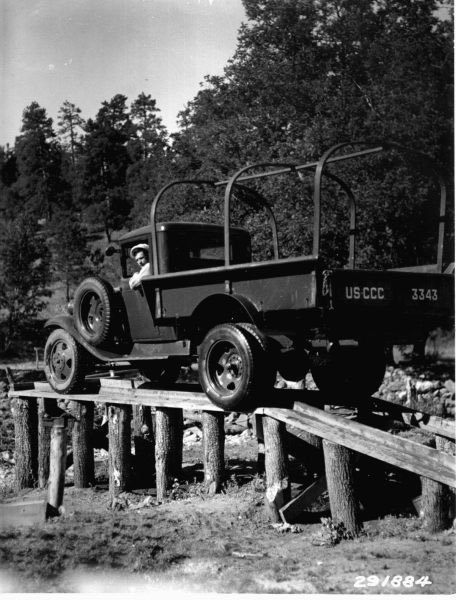
Statistically, the most dangerous daily activity facing CCC enrollees was injury or death caused by vehicular accidents.  Trucks transported enrollees to and from the work sites.  Trucks often brought lunches and extra supplies to the work site during the day.  Trucks carried enrollees into town on the weekend to take in a movie or to attend dances and trucks transported the enrollees back to camp when the fun was over.  Trucks transported company equipment between camps and trucks moved enrollees from summer camps to winter camps when the weather got cold, often moving them back the other direction in the spring.  No matter what the type of work being undertaken in the camp – forestry work, erosion control, construction of park improvements, or installation of irrigation systems – drivers were always the backbone of the effort. 

An enrollee stands next to his battered truck.
To be sure, in the first formative months of the program, the CCC lacked a robust safety program, and by October 1933 it became clear the organization had a safety problem.  Director Robert Fechner expressed dismay over the number of fatalities due to accidents in the CCC, but despite his admonitions, the record did not improve and talk turned to the creation of a formal safety program.  Finally, in April 1934, with the strong support of the War Department and the technical services like the Forest Service and the National Park Service, a formal safety program was adopted.  Under the program, CCC Safety Division representatives visited each camp.  William Rutherford, a US Forest Service foreman working in a camp on Colorado’s western slope, wrote home and mentioned that an inspector had recently visited camp and was upset that enrollees were jumping out of the backs of trucks before they’d come to a complete stop.  At some point, Rutherford found himself tasked with the job of managing the camp’s truck fleet, insuring the drivers were properly trained and maintaining their vehicles.  Safety committees were also established in each camp and by the middle of 1936 the death rate for CCC enrollees had been reduced to a point that was lower than that in the Regular army and lower for young men in the same age group in the overall population of the United States.

Grease rack, CCC camp Vale, Oregon, circa. 1940
Truck drivers were required to maintain their equipment and expected to operate it in a safe manner.  For example, in the camp at Vale, Oregon, Saturday’s were given over as time for drivers to service and maintain their trucks, which they did, using a large grease rack, built especially for the task.  A driver’s safety record and driving ability were documented and often referenced as part of their discharge paperwork; in part as a means of showing prospective employers that a particular young man had proven himself behind the wheel in the CCC.  
Merle Timblin (holding canteen) stands by his truck while a CCC work crew loads up.
Merle Timblin recalled his work driving a truck when his CCC company moved from Williams, Arizona to Nogales, Arizona.  The trucks carrying the camp equipment and supplies made the trip in two days, stopping in Phoenix overnight before continuing their journey to southern Arizona the next day.  Today, thanks to the interstate highway system, the trip can be accomplished in under a day, with time to spare for rest stops and sightseeing.
A truck driver’s code, issued to some drivers, including Merle Timblin, included the commitment to drive safely at all times and to strive diligently for a camp record of no lost time accidents.

To be sure, even with a strong safety program in the camps, accidents still happened and occasionally they were the result of misconduct on the part of one or more enrollees.  In these cases, the camp commander would convene a review board to determine the cause of the accident and, if necessary, levy appropriate sanctions.  Sadly, in the case of fatal accidents, the board would rule on whether the enrollee in question was at fault and whether the accident occurred in the performance of his regular duties.

A newspaper reports the sad details of a fatal truck accident near Wallace, Idaho.

The Death of Enrollee Rocco Martello, Yellowstone National Park, 1939
On October 3, 1939 a board of officers headed by Captain Harley Jones, issued findings in the matter of the death of enrollee Rocco R. Martello, who was a member of Company 3204 at the Nez Perce Camp YNP-5 near West Yellowstone, Montana.  Martello was a passenger riding in the back of a stake bed Ford truck returning to camp following an authorized recreation trip to West Yellowstone late on the night of August 12, 1939.  Approximately sixteen miles into the journey and within the boundaries of Yellowstone National Park, the driver was blinded by the lights of an oncoming vehicle.  In his effort to avoid a collision, the driver pulled the truck to the far right shoulder of the road, hitting a large rock, resulting in his loss of control of the truck, which careened over an embankment, rolling over in the process, coming to rest against some trees approximately 30 feet from the highway.  Enrollee Martello, seated on a bench seat in the rear of the truck was thrown from the truck and pinned to the ground by two trees that were uprooted by the rolling truck, the truck eventually coming to rest atop the uprooted trees and atop enrollee Martello. 
Captain Jones and the review board noted that enrollee Martello died almost instantaneously.  Additionally, the board ruled that the death occurred in the performance of duty and was not the result of Martello’s misconduct and that neither alcohol nor drugs were a direct or proximate cause of the fatality.

The board findings also include an affidavit from the driver of the truck, explaining the tragic details of the crash, noting that there were 23 enrollees in the rear of the truck and three, including the driver, riding in the cab.  The driver goes on to attest that he received no instruction regarding the fact that three men should not ride in the cab of a CCC truck.  Perhaps more tragic still, the driver admits to having had “about four beers” while in West Yellowstone that night, but goes on to claim that, “…there was no time in which I was not in full possession of my faculties.  I was perfectly sober when I started do drive the truck back to camp.”
    
The documentation available does not record what action might have been taken against the driver and it would be unfair to speculate now, some 73 years later.  It is enough to note that at least two lives were changed forever that night in Yellowstone National Park.  Today the incident merely serves to remind us of the burden carried by truck drivers in the CCC.

Motor pool, perhaps during vehicle inspection, CCC camp Vale, Oregon, 1940.
Sources

Proceedings of B/O, Enrollee Rocco R. Martello Findings, National Archives, Wash., DC.

Salmond, John A.  The Civilian Conservation Corps, 1933-1942:  A New Deal Case Study.  Durham, NC:  Duke University Press, 1967.