Showing posts with label Arizona. Show all posts

Monday, December 24, 2012

Christmas As Reported in the Camp Papers

Each year as Christmas rolls closer, it is difficult not to give some thought to what life must have been like in the CCC camps during the holidays.  Much of what we know about life in the camps during the holidays comes from reports in the individual camp newspapers.

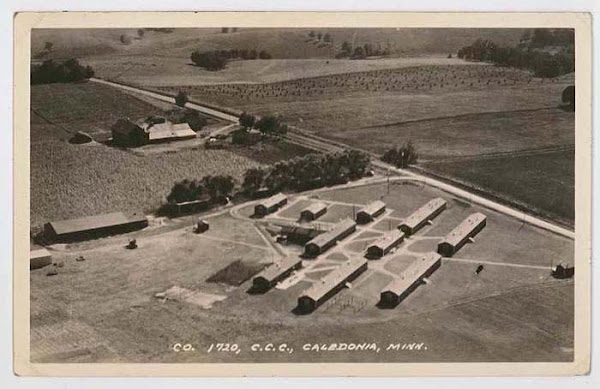
For the enrollees of Company 2704 at Camp SCS-4-M in Chatfield, Minnesota, December 1937 must have been a bittersweet time indeed.  Though Christmas and New Year were looming large on the calendar, so too was the prospect of having to disband the company.  So, while it was printed in hues of green and red, the cover of the Company 2704 camp newspaper for December 1937 didn’t depict an image of Santa Claus or reindeer, but rather a comical image of enrollees loading up their footlockers and barracks bags under the title “Final Edition.”
Nevertheless, whether in honor of the Christmas season or to mark the disbanding of the company, the paper announced that a dinner-smoker event was scheduled and that there would be, “an extra special dinner in the mess hall,” that would be “a second Thanksgiving feast.”

Many enrollees – indeed as many as could afford to and who had leave saved up – left camp to be with relatives.  The December, 1937 Hualpai Echo reported on the plans of some members of Company 1837 at camp SP-8-A near Kingman, Arizona:
Joe Snow, Lloyd Perry and George Edwards left the 16th for a holiday trip to Los Angeles and other points of interest along the Pacific seaboard.  They will return to spend New Year’s Day in camp.
Al Lancaster will spend his Yuletide vacation visiting his family in Tucson.

Manuel Franco, Luis Rios, Quintin Henderson and Joe Lopez will leave the 24th for San Diego where they will spend the holidays visiting relatives – so they say.  They also plan side trips to Tia Juana in Old Mexico and Los Angeles.
The article went on to explain that those enrollees staying in camp could look forward to something special too:

A Christmas Tree with all the trimmings is planned for the men staying in camp (for) Xmas.  A unique way of giving a present to everyone has been worked out.  The climax to the Xmas celebration in camp is the extra-special dinner which will satisfy the gastronic (sic) appetites of all.
At the bottom of the page was included a final admonition:  “Don’t forget a Christmas card to the folks back home…”  Good advice in 1937, good advice today.

Road project (in the snow). Company 1152, N. Stratford New Hampshire. First Corps Area.

Veterans in Company 1826V in the Nogales Sub-District in Arizona reportedly celebrated a quiet and dignified Christmas in camp according to an article in their Company paper:
Christmas at Camp F-30-A was very quietly but appropriately observed.  A large number of men were absent from camp for the weekend but those who were present participated in making Christmas of 1936 a very quiet but dignified occasion.
Judging from the great number of packages and cards, Santa Claus was unusually generous in his plans for the members of Company 1826.  “Merry Christmas” was the password of the company during the holiday season and a good time was had by all.

There seems little question that most camp commanders and technical agency staff worked hard to keep morale high during the holidays.  In her book Gold Medal CCC Company 1538, Kathy Mays Smith recounts the very special Christmas party held for the members of Company 1538 stationed at Camp Wyoming near Pineville, West Virginia in 1935.  The gala event was kept a secret from most of the enrollees right up until they filed into the festively decorated camp recreation hall.  The camp commander addressed the assembled men with greetings of the season before reciting Dickens’ “A Christmas Carol.”  An enrollee choir sang Christmas songs, including “Silent Night,” and three men, directed by an Army lieutenant, acted out a pantomime skit entitled “The Three Wise Men.”  But the high point of the evening came when,

“At last came the climax of the evening.  Instructed to line up in order to sign the payroll, as each one passed the table where the officers stood, he was handed, not a pen and a book full of dotted lines, but a real honest-to-goodness watch, the gift of the Administrative Personnel and Technical Service.”

Today it may be difficult to conceive of a time when so many had nothing or nearly nothing; a time when fresh fruit in a Christmas stocking was considered a luxury for some.  Homemade paper decorations and handwritten greetings have given way to brightly colored, electrical powered, mass produced displays made overseas.  However, if we concentrate for a moment and let our mind’s eye open to a vision of the past, we may still catch a glimpse of young men, far from home and family, gathered in a brightly lit mess hall or recreation building in a CCC camp nestled in a western forest, or perched on a ridgeline in an eastern state somewhere.  To be sure, there was sadness – there always is a bit of that; sadness at being away from loved ones perhaps, but the record shows that in the CCC camps there usually was some reason to be thankful and to smile even if that reason now seems so very simple by today’s over inflated standards.  Merry Christmas.
Timber crew on snow shoes. Company 182, West Cornwall, Conn. First Corps Area.


Tuesday, January 18, 2011

The C.C.C. State-By-State: Arizona

This marks the third state entry in the State-By-State series. If you’d like to get some background on the purpose and scope of this series, you can read the initial entry in the State-By-State series by clicking here. Over time, there may be a need to go back and revise the individual state entries in order to add new information or correct the information that is already posted, so if you’re interested in a particular state, be sure to check back from time to time to see if there are any updates.

Arizona is another state for which there has been some worthwhile and very useful CCC research done in the not too distant past, most notably Robert Moore’s book on the CCC in Arizona’s Rim Country, which we’ll touch on in a moment.

First, let’s start with some statistics from Perry Merrill’s book Roosevelt’s Forest Army. Merrill notes that the number of individual camps in the state of Arizona numbered about fifty and that the aggregate number of Arizona men who were given work as a result of the CCC stands at 41,363. Between 1933 and 1942, CCC enrollees in Arizona strung 3,559 miles of telephone lines, built 512,093 erosion control check dams and planted an astounding 7.4 million trees! Merrill also briefly notes the work of the CCC in Phoenix, Tucson, Colossal Cave and the Hualpai Mountains though an error in the text makes it seem that the Hualapai Mountains are in or near Tucson, when in fact they are in the opposite corner of the state, near Kingman, Arizona. (You’ll also note the various spellings of “Hualapai”.)

For many years and importantly during the Great Depression, Arizona had a wonderful advocate in the person of Senator Carl Hayden. To read about the creation of the CCC camps at Phoenix South Mountain Park – including Senator Hayden’s role in the effort – click on my previous post about the CCC at South Mountain Park. It is safe to say that were it not for Senator Hayden, Phoenix would not have gotten at least two of the CCC camps that it was allotted during the 1930s. One can only imagine what other help Senator Hayden provided to insure the success of the CCC in Arizona.

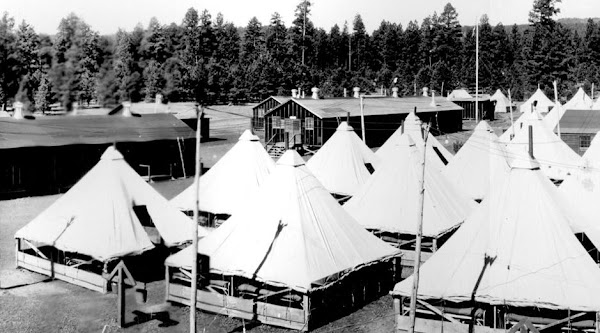
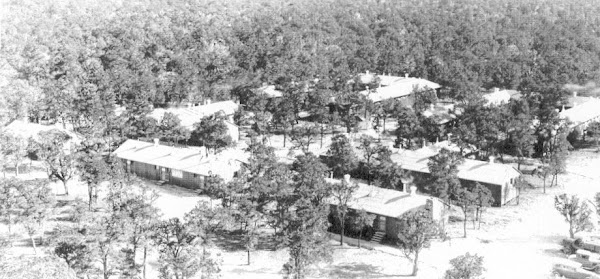
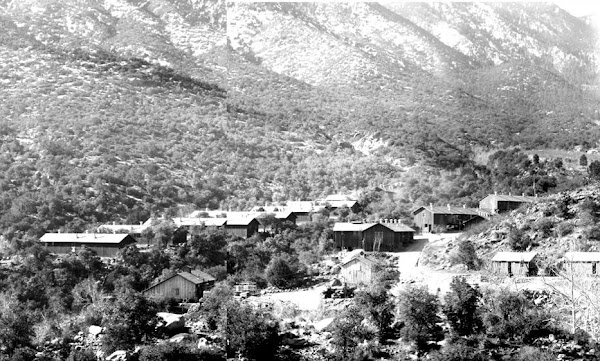
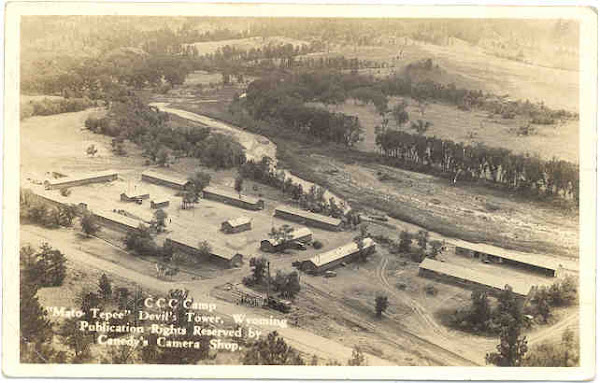
The CCC also worked at Papago Park, another park located in the Phoenix metropolitan area. Lesser known though vaguely referenced in Roosevelt’s Forest Army, is the work at Hualapai Mountain Park near Kingman, Arizona. You can see an all too brief history of the park by clicking on the Mojave County Parks website here. The 1936 Phoenix District Annual reported that at that time Company 1837 was working at camp SP-8-A in the “Hualpai” Mountains. Prior to arriving near Kingman, Company 1837 worked at SP-1-A in Randolph Park near Tucson and then camp SP-6-A in Tucson’s Rincon Mountains. (The black and white photos of SP-8-A in this post are from that 1936 District Annual.) Given the fact that the place owes its existence to the CCC, more could be done to document and report on the work of the CCC at Hualapai Mountain Park.

A thumbnail sketch of the places where the CCC worked in Arizona would look something like this:
Multiple improvements like roads, ramadas and lookout structures at both Phoenix South Mountain Park and Papago Park, infrastructure and aesthetic improvements at Grand Canyon, both on the North and South Rims and down in the Canyon. Additionally, upgrades and improvements to the irrigation system in the metro Phoenix area and in the area around Yuma, erosion control work throughout the state, significant improvements at Colossal Cave and Chiricahua National Monument in southeastern Arizona, immeasurable improvements to the forest lands across the state and work at Petrified Forest.

Two books come to mind when discussing the work of the CCC in Arizona: Louis Lester Purvis’ wonderful book The Ace in the Hole: A Brief History of Company 818 of the Civilian Conservation Corps (1989) and Robert J. Moore’s more recent, more scholarly book The Civilian Conservation Corps in Arizona’s Rim Country: Working in the Woods (2006). Purvis’ book on the work of the CCC at Grand Canyon stands head and shoulders above other Arizona-related works because it is the only published text that is a personal narrative penned by a CCC veteran who worked in Arizona and I’ve been remiss in not posting a detailed review of it here or at the Forest Army blog. To read an earlier posting I did for Moore’s book, over at Forest Army click here. Bottom line: If you’re doing research on the work of the CCC in Arizona, these two books will be an important resource for you.

Other equally important if less in-depth coverage of CCC work in Arizona can be found in Sharon Hunt’s Images of America book entitled Vail and Colossal Cave Mountain Park and Donna and George Hartz’s Images of America book entitled The Phoenix Area’s Parks and Preserves, both published by Arcadia Publishing. (Any time to encounter an Arcadia Publishing Images of America title, be sure to scan through it for images and references to the CCC – you’ll be surprised at how often these titles include references to work done by the Forest Army during the 1930s.) Elsewhere, you’ll find references to the CCC in Letters from Wupatki by Courtney Reeder Jones and Bradford Luckingham’s Phoenix: A History of a Southwestern Metropolis. (Admittedly, the single reference to the CCC in Luckingham is a bit thin but the book also provides useful insight into life in Phoenix during the New Deal era.)

To view all of the Arizona-related posts over at the Forest Army blog, click here.

Interest in the work of the CCC in Arizona remains strong and the Arizona State Archives now maintains a set of all available issues of the CCC newspaper Happy Days on microfilm.

The map for this post (as with all maps used thus far) comes from a map of camp locations published in Cohen’s The Tree Army. The color photo of the CCC-built cabin comes from the Mojave County Parks website and the black and white images of the CCC camp at Hualpai Mountain Park are from the 1936 Phoenix District Annual.

Sunday, April 18, 2010

More Arizona CCC News!

The acclaimed National Park Service exhibit It Saved My Life, which originated at Grand Canyon National Park in 2008, is finding continued life with the upcoming opening of the exhibit in Tucson, Arizona.

Following a wonderful run in historic Kolb Studio on Grand Canyon’s South Rim, the exhibit was loaned to the City of Phoenix and was set up at Phoenix South Mountain Park. The opening of the exhibit there coincided with the dedication of a CCC Worker Statue at the park.

Now comes word that the exhibit will open for public visitation at the Arizona History museum in Tucson starting Friday, May 14th. There is no immediate word on how long the exhibit will run however the exhibit title has been revised to incorporate the local story of CCC work in Southern Arizona as well. The Arizona Historical Society and the Arizona Humanities Council have teamed up to make the exhibit possible. The announcement for the exhibit opening indicates that on the evening of May 14th visitors will have an opportunity to view the exhibit meet CCC enrollees and enjoy refreshments. On Saturday, May 22nd the museum will host a Family Program during which visitors will be able to go on a family-friendly tour, listen to a fireside chat with FDR and participate in hands-on activities.

It is a tribute to the hard work of folks with the National Park Service that this exhibit continues to enrich people’s lives even after its terrific run at Grand Canyon. It is a further tribute to hard working folks at the local level in Phoenix and Tucson who’ve worked to extend the usefulness of this wonderful exhibit so that it continues to teach people about the work of the CCC in Arizona.

Wednesday, March 24, 2010

Big News for CCC Researchers in Arizona!

In the coming weeks, Chapter 44 of the Civilian Conservation Corps Legacy will donate to the Arizona State Archives a complete set of the available Happy Days newspapers on microfilm!

The film contains issues of Happy Days from 1933 to 1940 and cost just over $500, purchased from the National Archives and Records Administration. The acquisition of this film and its donation to a local repository has huge implications for anyone wanting to do CCC research in Arizona, but as important as it is, the microfilm is only a tool and without a proper finding aid or index, this volume of material is little more than a novelty and a place for researchers to scan randomly with the hope that they will stumble onto information that is useful to their project.

Enter Bob Audretsch, U. S. Park Service retired. Bob has very kindly given his time and talent, devoting hours to scanning the entire six-roll collection to catalog and index every story in the Happy Days film with an Arizona connection. Bob estimates that the work of indexing the Arizona Happy Days stories took six months, working an average of 4 hours a day. Bob’s not new to this, having already indexed CCC stories in two Flagstaff papers and one Williams paper from the 1930s. And, amazingly enough, Bob’s not done; he’s begun work indexing papers from Winslow, Holbrook, Springerville, Camp Verde, Kingman, Prescott and Phoenix. When Bob’s done, much of the heavy lifting will have been accomplished for any researcher hoping to glean CCC stories from Arizona’s major newspapers from the New Deal era.


So, in this project we have the beneficial intertwining of a CCC Legacy chapter with the interest and hard work of a local CCC author and researcher. Chapter 44 has provided the funding for the purchase of the Happy Days on microfilm and Bob Audretsch has provided the sweat of his brow to produce an index that will make the microfilm that much more useful to Arizona researchers.

I’ll provide an update here, once the microfilm is handed over to the Arizona State Archives.

Sunday, November 25, 2007

It Wasn't Always About Work In the CCC

How much free time do you have each week? What do you do with your free time?
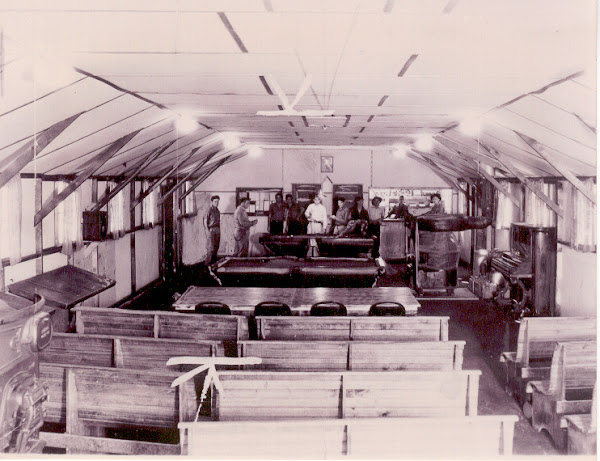
Civilian Conservation Corps enrollees generally worked on field projects Monday through Friday, 8 hours a day, and half a day in camp on Saturdays. Evenings and part of the weekend were reserved for leisure time and usually enrollees were allowed to spend their free time any way they saw fit. Most camps offered classes after the evening meal and there was almost always a recreation hall in the camp where enrollees could play games like billiards, ping pong or cards. A camp library was usually stocked with magazines and books and this was usually a quiet place where enrollees could study or write letters home. At least one camp library even had a sign that read, "Have you written home this week?"

Camp Library, Riley Creek Wisconsin. The sign reads: "Do It Now."


Camps that were located close to towns and cities generally had fewer morale problems than camps that were located far from population centers. When a camp was located close to a town or city, the camp commander usually authorized the use of a vehicle to carry enrollees into town on the weekend so they could see a movie or attend a dance. At least one camp commander obtained movie tickets from a local theatre owner and offered them as a reward to the enrollees in his camp.

Most camps also had a camp "canteen" that sold small items like candy bars, gum, tobacco and simple luxury items. The funds raised in the canteen were often used to buy sports equipment for the company or to fund other company activities.

The camp recreation hall and canteen for Company 847, Grand Canyon.

One of the most remote camps was located at the bottom of Grand Canyon, near Phantom Ranch. (This was one of about six CCC camps at Grand Canyon National Park.) Enrollees assigned to the Phantom Ranch camp carried a pool table from the south rim to their camp in order to have some new entertainment in their recreation hall!


Enrollees from Company 818 play croquet at the bottom of Grand Canyon.


What would you be willing to do in order to have something to do in your spare time?