Showing posts with label John A. Salmond. Show all posts

Monday, January 27, 2014

Thank you, John Salmond


For anyone who makes even a passing study of the subject, the arc of Civilian Conservation Corps history swings right through John A Salmond’s book The Civilian Conservation Corps, 1933-1942: A New Deal Case Study.  Open any scholarly work on the subject of the CCC and odds are good you’ll see Salmond listed in the notes.  I refer to Salmond’s book nearly every time I fire up the computer to write and I have done so for more than 20 years.

Occasionally I will conduct an internet search for Dr. Salmond and it was in this way that I contacted him by email back in early 2006.  In a gracious response to a stranger’s email from overseas Dr. Salmond expressed surprise over the long-running success of his book, writing, “…it has always surprised me that my little book, now long out of print, remains the standard work on the Corps.”  To my great surprise and satisfaction, Dr. Salmond also agreed to help me with my CCC writing efforts, including the book on which it seems I have been “working” for years.  Sadly, while I remain optimistic that I will actually complete my own book on the Civilian Conservation Corps, John Salmond will definitely not be writing the forward for that book as I had originally hoped.

Last week, during one of my occasional internet searches for “John A. Salmond,” I found a La Trobe University tribute to the late professor, which you can view here.   It seems Dr. Salmond passed away last summer.

It is no exaggeration to say that John Salmond’s work is the foundation upon which some 40 odd years of Civilian Conservation Corps scholarship rests.  When a historian, scholar or freelance researcher works on CCC history, they stand on John Salmond’s shoulders.  My interest in the CCC was fired initially by my grandfather’s work for the Forest Service in the 1930s but my ongoing work and research of the CCC has been propelled forward because, early on, in an Arizona State University library, I discovered John A. Salmond’s valuable contribution to the study of our beloved Civilian Conservation Corps.  Godspeed, Dr. Salmond, and thank you.

Photo of John A. Salmond is from the La Trobe University website.  Image of the book cover, from the author’s collection.

©Michael I. Smith, 2014

Monday, August 5, 2013

State-By-State: Kentucky


1938 Camp Map for Kentucky
If you are looking for detailed information on the work of the CCC in Kentucky, you’re really in luck because there is at least one book devoted to CCC work in that state.  Kentucky’s Civilian Conservation Corps by Connie M. Huddleston will be a boon to anyone researching Kentucky’s CCC work; the photos and illustrations alone make it a real treasure.  I am especially drawn to Huddleston’s text and photos related to the work of the CCC at Cumberland Falls State Park.  A few years ago, the annual Civilian Conservation Corps reunion was held at Cumberland Falls State Park so in the case of Kentucky, I have some photos of my own to share.  To access an article about the reunion that I posted at the Forest Army blog back in 2007, click here.

Huddleston notes that the first CCC camps established in Kentucky were those at Cumberland Falls and Mammoth Cave and that by October 1935 a total of 35 camps had been opened in the Bluegrass State.  More to the point, Perry Merrill provides a snapshot of camp totals in his book Roosevelt’s Forest Army.  According to Merrill, there were 44 CCC camps in Kentucky in June 1937.  This total is likely taken from the annual reports published by the U.S. Government Printing Office in Washington, D.C.  The Annual Report of the Director of Emergency Conservation Work for fiscal year ended June 30 1937 gives the breakdown of camps by types in Kentucky exactly as reported by Merrill, specifically:
CCC-built bench and steps, Cumberland Falls, KY
National Forest Camp: 8
State Forest Camps: 1
Private Forest Camps: 8
Agricultural Engineering Camps: 2
Soil Conservation Camps: 14
National Parks Camps: 4
State Park Camps: 6
Military Reservation Camps: 1

The total monthly enrolled strength for enrollees entering the CCC from Kentucky in fiscal year 1937 was reported as follows:

July 1936:  11,272
August 1936:  10,750
September 1936:  8,907
Ft Knox CCC Conditioning Camp, 1934
(Click to enlarge.)
October 1936:  13,289
November 1936:  12,779
December 1936:  12,158
January 1937:  12,901
February 1937:  12,342
March 1937:  8,392
April 1937:  12,641
May 1937:  12,014
June 1927:  10,956

The Annual Report of the Director of the Civilian Conservation Corps for fiscal year ended June 30, 1939 reported that the total number of camps in Kentucky was down to 28, broken down as follows:

National Monument Camps:  3
State Park Camps: 3
National Forest Camps: 4
State Forest Camps: 1
Private Forest Camps: 5

Agricultural Engineering Camps: 2

Soil Conservation Service Camps: 10


It is worth noting that along with the lower number of camps in Kentucky in fiscal year 1939 compared to fiscal year 1937, the number of enrollees joining the CCC from Kentucky each month was also significantly lower in 1939; just 7,631 in July 1938, 7,271 in November 1938, 7,111 in January 1939 and 4,169 in March of 1939.  One might speculate as to the reason behind such a drop in enrollment numbers from 1937 to 1939 (the enrollment count for Kentucky in March 1939 was only about half of what it was compared to March 1937).  Perhaps the economy was improving, perhaps there were more agricultural jobs available for seasonal workers.  Perhaps Kentucky’s quota of enrollees had been reduced.  We do know that by 1939 enrollees from eastern states, including Kentucky, were being shipped out to the western United States where there was a greater need for their labor.

In his book The Civilian Conservation Corps, 1933-1942, John Salmond points to an even more compelling reason for a decline in enrollment numbers between 1937 and 1939.  After some four years of priming the nation’s economic pump, the Roosevelt administration was desperate to rein in spending and to balance its budget.  Consequently, in late 1937 CCC Director Robert Fechner was told that estimates for the 1938-1939 fiscal year had been reduced by $125 million.  Fechner pointed out that this would mean closing just over 400 CCC camps nationwide by July of 1938 but his protests fell on deaf ears.  The reductions were made as a budget balancing measure and this is likely one major reason for the reduction in the number of camps in Kentucky between fiscal year 1937 and fiscal year 1939.

Even with a reduction in the total number of camps, the CCC accomplished great things in Kentucky during fiscal year 1939.  Here are some examples from that year alone, taken from the Annual Report for 1939:

Vehicle Bridges:  14
Pipeline:  11,654 linear feet
Permanent Check Dams:  73
Temporary Check Dams:  3,305
Seed Collection, Conifers:  79 bushels
Seed Collection, Hardwoods:  10,536 bushels
Collection of Tree Seedlings:  9,270 seedlings
Firefighting, Forest Fires:  10,515 man days


Remember that these figures are for a single year (1938-1939).  Multiply this effort over the 9 year lifespan of the CCC and you truly have a noteworthy list of accomplishments in Kentucky alone.  Naturally, this effort was not accomplished without some sacrifice, and the cost was occasionally documented in the pages of Happy Days, the official newspaper of the CCC.  Likely the first incidence of a CCC fatality in Kentucky to be documented in Happy Days was the death of Jack Stafford, which was reported in the April 14, 1934 issue.  Jack was killed in a truck accident during a trip home and it would seem that enrollees in Kentucky were especially prone to accidents during their free time.  The March 3, 1940 issue of Happy Days reported that Daniel Miller, an enrollee with Company 512 at Chappell, Kentucky, was accidently shot and killed by his nephew while on leave.  The August 3, 1940 issue reported the death of enrollee John Elliot, also from Company 512 at Chappell.  Elliot was killed in an auto accident en route back to camp while on leave.   W.P. Harris, an enrollee with Company 1562 at Madisonville, Kentucky was killed in a work related truck accident (Happy Days, August 4, 1934) and Carl F. Snyder of Company 563, Corbin, Kentucky, was killed in a logging accident (Happy Days, May 25, 1935).

By and large, CCC camps were welcomed by residents of nearby communities.  It is estimated that the establishment of a CCC camp meant an additional $5,000 in expenditures in the local community so it makes sense that local towns would welcome the CCC simply from a monetary standpoint.  But CCC enrollees often endeared themselves to residents of nearby cities and towns as a result of their work and often as a result of their behavior.  In The CCC Chronicles, Alfred Cornebise notes that the local librarian in Henderson, Kentucky was moved to write an editorial about the local CCC camp, her words of praise appeared in the Company 1540 camp newspaper, the Cromwell Cardinal.  The librarian wrote that “rarely does a detachment of men, stationed near a town, make the good impression on the community that the CCC Camp has made on Henderson…  This most satisfactory condition is due, of course, not only to the boys but to the institution of the camp, to its discipline, its educational system, to its general conditions.”
CCC-built stone steps and retaining wall, Cumberland Falls, Kentucky


Sources

Cornebise, Alfred Emile, The CCC Chronicles: Camp Newspapers of the Civilian Conservation Corps, 1933-1942. Macfarland and Co., Jefferson, North Carolina, 2004.

Huddleston, Connie, M., Kentucky’s Civilian Conservation Corps.  The History Press, Charleston, South Carolina, 2009.

Merrill, Perry H, Roosevelt’s Forest Army, 1981, Perry H. Merrill, Publisher.

Salmond, John A., The Civilian Conservation Corps, 1933-1942:  A New Deal Case Study.  Duke University Press, Durham, North Carolina, 1967


U.S. Government Printing Office, Annual Report of the Director of Emergency Conservation Work, Fiscal Year Ended June 30, 1937.

U.S. Government Printing Office, Annual Report of the Director of the Civilian Conservation Corps Fiscal Year Ended June 30, 1939.

Copyright, 2013, Michael I. Smith

Wednesday, September 19, 2012

Truck Drivers in the CCC: There Was a Lot Riding on their Work


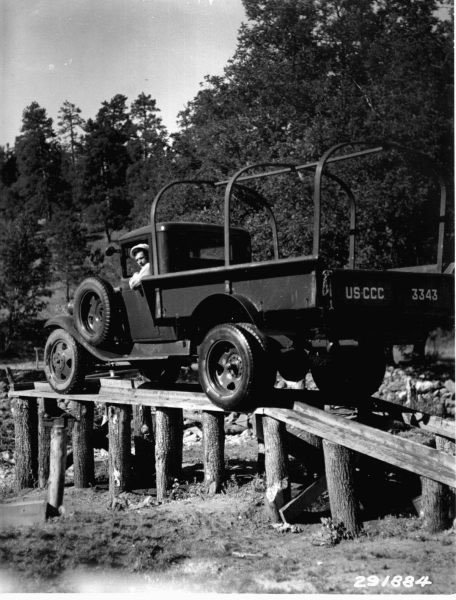
Statistically, the most dangerous daily activity facing CCC enrollees was injury or death caused by vehicular accidents.  Trucks transported enrollees to and from the work sites.  Trucks often brought lunches and extra supplies to the work site during the day.  Trucks carried enrollees into town on the weekend to take in a movie or to attend dances and trucks transported the enrollees back to camp when the fun was over.  Trucks transported company equipment between camps and trucks moved enrollees from summer camps to winter camps when the weather got cold, often moving them back the other direction in the spring.  No matter what the type of work being undertaken in the camp – forestry work, erosion control, construction of park improvements, or installation of irrigation systems – drivers were always the backbone of the effort. 

An enrollee stands next to his battered truck.
To be sure, in the first formative months of the program, the CCC lacked a robust safety program, and by October 1933 it became clear the organization had a safety problem.  Director Robert Fechner expressed dismay over the number of fatalities due to accidents in the CCC, but despite his admonitions, the record did not improve and talk turned to the creation of a formal safety program.  Finally, in April 1934, with the strong support of the War Department and the technical services like the Forest Service and the National Park Service, a formal safety program was adopted.  Under the program, CCC Safety Division representatives visited each camp.  William Rutherford, a US Forest Service foreman working in a camp on Colorado’s western slope, wrote home and mentioned that an inspector had recently visited camp and was upset that enrollees were jumping out of the backs of trucks before they’d come to a complete stop.  At some point, Rutherford found himself tasked with the job of managing the camp’s truck fleet, insuring the drivers were properly trained and maintaining their vehicles.  Safety committees were also established in each camp and by the middle of 1936 the death rate for CCC enrollees had been reduced to a point that was lower than that in the Regular army and lower for young men in the same age group in the overall population of the United States.

Grease rack, CCC camp Vale, Oregon, circa. 1940
Truck drivers were required to maintain their equipment and expected to operate it in a safe manner.  For example, in the camp at Vale, Oregon, Saturday’s were given over as time for drivers to service and maintain their trucks, which they did, using a large grease rack, built especially for the task.  A driver’s safety record and driving ability were documented and often referenced as part of their discharge paperwork; in part as a means of showing prospective employers that a particular young man had proven himself behind the wheel in the CCC.  
Merle Timblin (holding canteen) stands by his truck while a CCC work crew loads up.
Merle Timblin recalled his work driving a truck when his CCC company moved from Williams, Arizona to Nogales, Arizona.  The trucks carrying the camp equipment and supplies made the trip in two days, stopping in Phoenix overnight before continuing their journey to southern Arizona the next day.  Today, thanks to the interstate highway system, the trip can be accomplished in under a day, with time to spare for rest stops and sightseeing.
A truck driver’s code, issued to some drivers, including Merle Timblin, included the commitment to drive safely at all times and to strive diligently for a camp record of no lost time accidents.

To be sure, even with a strong safety program in the camps, accidents still happened and occasionally they were the result of misconduct on the part of one or more enrollees.  In these cases, the camp commander would convene a review board to determine the cause of the accident and, if necessary, levy appropriate sanctions.  Sadly, in the case of fatal accidents, the board would rule on whether the enrollee in question was at fault and whether the accident occurred in the performance of his regular duties.

A newspaper reports the sad details of a fatal truck accident near Wallace, Idaho.

The Death of Enrollee Rocco Martello, Yellowstone National Park, 1939
On October 3, 1939 a board of officers headed by Captain Harley Jones, issued findings in the matter of the death of enrollee Rocco R. Martello, who was a member of Company 3204 at the Nez Perce Camp YNP-5 near West Yellowstone, Montana.  Martello was a passenger riding in the back of a stake bed Ford truck returning to camp following an authorized recreation trip to West Yellowstone late on the night of August 12, 1939.  Approximately sixteen miles into the journey and within the boundaries of Yellowstone National Park, the driver was blinded by the lights of an oncoming vehicle.  In his effort to avoid a collision, the driver pulled the truck to the far right shoulder of the road, hitting a large rock, resulting in his loss of control of the truck, which careened over an embankment, rolling over in the process, coming to rest against some trees approximately 30 feet from the highway.  Enrollee Martello, seated on a bench seat in the rear of the truck was thrown from the truck and pinned to the ground by two trees that were uprooted by the rolling truck, the truck eventually coming to rest atop the uprooted trees and atop enrollee Martello. 
Captain Jones and the review board noted that enrollee Martello died almost instantaneously.  Additionally, the board ruled that the death occurred in the performance of duty and was not the result of Martello’s misconduct and that neither alcohol nor drugs were a direct or proximate cause of the fatality.

The board findings also include an affidavit from the driver of the truck, explaining the tragic details of the crash, noting that there were 23 enrollees in the rear of the truck and three, including the driver, riding in the cab.  The driver goes on to attest that he received no instruction regarding the fact that three men should not ride in the cab of a CCC truck.  Perhaps more tragic still, the driver admits to having had “about four beers” while in West Yellowstone that night, but goes on to claim that, “…there was no time in which I was not in full possession of my faculties.  I was perfectly sober when I started do drive the truck back to camp.”
    
The documentation available does not record what action might have been taken against the driver and it would be unfair to speculate now, some 73 years later.  It is enough to note that at least two lives were changed forever that night in Yellowstone National Park.  Today the incident merely serves to remind us of the burden carried by truck drivers in the CCC.

Motor pool, perhaps during vehicle inspection, CCC camp Vale, Oregon, 1940.
Sources

Proceedings of B/O, Enrollee Rocco R. Martello Findings, National Archives, Wash., DC.

Salmond, John A.  The Civilian Conservation Corps, 1933-1942:  A New Deal Case Study.  Durham, NC:  Duke University Press, 1967.

Monday, March 21, 2011

The C.C.C. State-BY-State: Georgia

Georgia was situated in the 4th Corps area along with North Carolina, South Carolina, Florida, Alabama, Tennessee, Mississippi and Louisiana. The 4th Corps area was commanded by Major General George Van Horn Moseley, who wrote of the CCC: “Though I feel that all of the participating Federal departments – Agriculture, Interior, Labor, and War – have done a fine job, the credit for the wonderful reputation achieved by the Civilian Conservation Corps must go primarily to the lads themselves. I have never seen a finer group of young men. They have met their part of the bargain just one hundred percent, and they have reaped a just reward.” (Moseley's comments appeared as a preface to a 1935 District "E" Annual. It should be noted that Moseley's high opinion of CCC enrollees may not have extended to all enrollees. Salmond refers to him as a "quasi-fascist" and by inference we can assume he may not have been highly in favor of the recruitment of black enrollees into the CCC.)

The Federal Security Agency Annual Report of the Director of the Civilian Conservation Corps for fiscal year 1942 includes the following detailed reference to CCC work in Georgia on page 48 under the heading Southern Region – Atlanta, Georgia. The entry states:
“Largely through the fire control improvements and facilities constructed by the CCC, it has been possible for the State Foresters in the Southern Region to provide fire control for millions of acres of privately owned timber lands that otherwise would have continued to suffer severe damage annually. At the beginning of the CCC program in 1933 there were about 47 million acres in the South receiving fire protection. By January 1, 1942, this had increased to 75 million acres.”

No doubt, Georgia garnered its share of important forest protection improvements in the southern United States as well as other valuable work by the creation of the CCC in 1933. Perry Merrill breaks out some of the work totals in his book Roosevelt’s Forest Army. For example, in Georgia, between 1933 and 1942, the CCC strung 3,638 miles of telephone lines, build 425,829 check dams and erosion control features, planted over 22 million trees and spent over 153,000 man-days fighting forest fires. Dependents living in Georgia received over $19 million in allotments from enrollees during that time!

As for the aforementioned forest protection work, the CCC erected 500-watt radio transmitters at two sites to improve communication between fire towers and fire crews. Additionally, the CCC built facilities at Timber Protective Organization sites established as part of a state program.

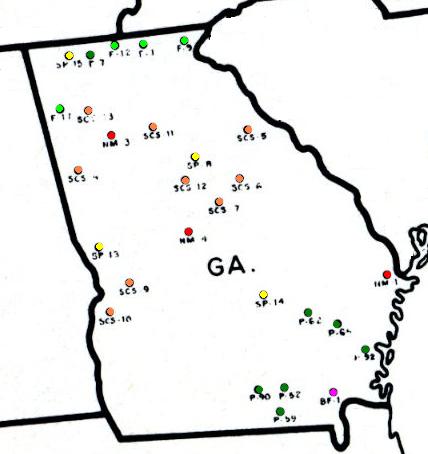
Merrill notes that the average number of CCC camps to operate in Georgia was 35 and we can compare this average against camp totals for 1937 and 1939. According to the 1937 Annual Report of the Director of Emergency Conservation Work, in fiscal year 1937 a total of 40 CCC camps operated in Georgia, distributed as follows:
National Forest camps: 9
Private Forest camps: 10
Soil Conservation camps: 9
National Monument camps: 2
State Park camps: 6
Military Reservation camps: 4
In fiscal year 1939 the Annual Report of the Director of the Civilian Conservation Corps reports that a total of just 27 CCC camps operated in Georgia, distributed as follows:
National Park camps: 3
State Park camps: 4
National Forest camps: 5
Private Forest camps: 5
Biological Survey camps: 1
Soil Conservation camps: 9
(It’s interesting to note that between 1937 and 1939 the title of the annual report changed to reflect the program’s change from being called Emergency Conservation Work to Civilian Conservation Corps.)

As for enrollment, the Annual Reports also list enrollment totals for 1937 and 1939 that provide a snapshot look at CCC enrollment in Georgia. Georgia’s monthly enrollment totals for fiscal year 1937 stack up like this:
July 1936: 12,299
August 1936: 11,605
September 1936: 9,941
October 1936: 12,350
November 1936: 11,706
December 1936: 11,150
January 1937: 12,125
February 1937: 11,675
March 1937: 9,752
April 1937: 10, 593
May 1937: 10, 182
June 1937: 9, 503

The Annual Report for fiscal year 1939 shows a noticeable drop in monthly enrollment in the state of Georgia:
July 1938: 9,250
August 1938: 8,906
September 1938: 8,013
October 1938: 9,179
November 1938: 8,942
December 1938: 8,540
January 1939: 9,060
February 1939: 8,773
March 1939: 5,684
April 1939: 8,949
May 1939: 8,693
June 1939: 7,958

The Georgia Department of Natural Resources has a terrific page that lists CCC-built structures in the State Parks that you can still enjoy today. Click here to see the list.

There is a short paper on the history of the CCC in Georgia posted at the website of the Civilian Conservation Corps Legacy. Written by Betty van Dongeren in 2007, the paper seems to deal more with the overall history of the CCC with a few references to work in Georgia, but it includes a list of sources and some photos. You can view the paper as a pdf document here.

Racism in the CCC was not a problem solely in the southern United States, however in the South where Jim Crow laws held sway for decades even after the end of the CCC, the issue of race in the CCC is particularly powerful. John Salmond’s seminal work on the CCC, an online copy of which you can read here, includes a chapter titled “The Selection of Negroes.” Salmond makes particular reference to Georgia in the third paragraph of this chapter, writing: “Scarcely had selection [of CCC enrollees] begun, however, when reports from the South indicated that in that desperately poor region local selection agents were deliberately excluding Negroes from all CCC activities. Particularly deplorable were events in Georgia, which had a Negro population of 1,071,125 in 1930, or 36 per cent of the total state population. On May 2, 1933, an Atlanta resident, W.H. Harris, protested to the secretary of labor that in Clarke County, Georgia, with a 60 per cent Negro population, no non-whites had yet been selected for CCC work. Persons, director of CCC selection, immediately demanded an explanation from the Georgia state director of selection, John de la Perriere. The Georgia director blandly replied that all applications for CCC enrolment in Clarke County were “classed A, B and C. All colored applications fell into the classes B and C. The A class being the most needy, the selections were made from same.”

Despite further complaints from local groups, like the Atlanta branch of the National Urban League, officials in Washington preferred to remain outside the fray, with the hope that the situation would adjust itself, “without any apparent intervention from Washington.” But as it turned out, such a hands-off approach was not going to work over the long run and Director of CCC Selection Persons again followed up with the director of CCC selections in Georgia (John de la Perriere), this time by telephone. De la Perriere ultimately admitted that blacks were not being selected but denied it was on account of racism but rather, de la Perriere said that, “at this time of the farming period in the State, it is vitally important that negroes remain in the counties for chopping cotton and for planting other produce.” Persons knew better simply by looking at Georgia’s population statistics compared to enrollment of blacks in the CCC. Eventually it took a call to the governor of Georgia and a threat to withhold Georgia’s entire CCC enrollment quota to improve the situation; although one could easily argue that the issue of black CCC enrollment in the South was never fully resolved given that blacks were never represented in the CCC in numbers equal to their percentage of the population.

Ultimately, the experience of black enrollees in Georgia and nationwide, must be viewed through the prism of history and judged today as a series of small success that came about despite an overarching attitude of prejudice at the time. While the documentation records scores of vile episodes where blacks were denied the same opportunities in the CCC as their white counterparts, the record also reflects that local communities, in Georgia and nationwide, frequently embraced the all-black CCC companies that moved into their neighborhoods and often fought to keep them. For a longer, more detailed discussion of the African-American experience in the CCC, see the recent post over at Forest Army.

Larry N. Sypolt’s book Civilian Conservation Corps: A Selectively Annotated Bibliography includes a number of listings for material dealing with the work of the CCC in Georgia, including the following items:

“The New Deal and Georgia’s Black Youth,” by Michael S. Holmes in the Journal of Southern History 38 (August 1972), pages 443-460.

“The Civilian Conservation Corps and the State Park: An Approach to the Management of the Designed Historic Landscape Resources at Franklin D Roosevelt State Park, Pine Mountain Georgia,” a 1992 University of Georgia Master’s thesis by Lucy Ann Lawliss.

Mountaineers and Rangers: A History of the Federal Forest Management in the Southern Appalachians, 1900-81, by Shelley Smith Mastran, published by the U.S. Department of Agriculture Forest Service, Washington, DC, 1971.

NAACP Legal File: Cases Supported, CCC Boys, 1938-1939, National Association for the Advancement of Colored People, Frederick, MD, University Publications of America, 1988. This particular resource deals with the NAACP’s involvement in the cases of three Black CCC enrollees charged with murder in Georgia.

To view a collection of photos related to the work of the CCC in Georgia, visit Vanishing Georgia, the Digital Library of Georgia. Once there, type in “Civilian Conservation Corps” in the search box and be amazed at what you find.

For an interesting page on Kennesaw Mountain National Battlefield Park and the location of its CCC camp remnants, visit Waymarking.com. While you’re there, open the entire folder of waymarked CCC sites and you’ll marvel at the nearly 200 sites listed (to date). While we’re at it, here’s a link to the waymarking page for a CCC built bridge at Indian Springs State Park, Georgia. This website is particularly interesting and useful if you’re looking for CCC work in your region or neighborhood.


The December 16, 1933 issue of Happy Days reported the death of enrollee Alton Thrasher of Company 456, Robertstown, Georgia, in an automobile accident. The January 19, 1935 issue of Happy Days reported the death of Bill Bruner of Company 1414. Bruner was reportedly killed in a diving accident.
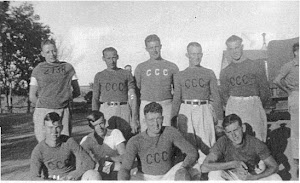
Sources: As with all the State-By-State posts, the map was taken from Stan Cohen's Tree Army. I highlighted the camp locations with colored dots for easier reference. The photo is of the Company 446 baseball team at camp D-92-G, Brunswick, Georgia and it also comes from the Cohen book. The Happy Days newspaper masthead was scanned from an original copy in my collection.

Monday, January 24, 2011

The C.C.C. State-By-State: Arkansas

In Roosevelt’s Forest Army, Perry Merrill devotes a good deal of space to a detailed accounting of CCC work in Arkansas (nearly 2 and a half pages, whereas Arizona garners barely a half page). We’ll find as we progress through all the states and territories that some places simply have better documentation of their CCC work and perhaps this is what Mr. Merrill encountered when he created his entry for Arkansas.

Let’s start with some simple statistics from Roosevelt’s Forest Army. An astounding 62, 882 individuals from all states worked in the CCC in Arkansas between 1933 and 1942. In that time, the CCC built 4,956 bridges of varying types, strung 6,956 miles of telephone line, built 82,190 check dams and made forest stand improvements to some 496,000 acres of land.

The 1937 Annual Report of the Director of Emergency Conservation Work includes a state-by-state monthly breakdown of the numbers of enrollees from each state. Enrollment in Arkansas for fiscal year 1937 stacked up like this:

July 1936: 8,539
August 1936: 8,144
September 1936: 6,226
October 1936: 11,049
November 1936: 10,681
December 1936: 10,307
January 1937: 10,291
February 1937: 9,976
March 1937: 7,471
April 1937: 10,329
May 1937: 9,931
June 1937: 9,295

(Keep in mind that these figures represent the number of enrollees who enrolled in Arkansas, not the number of enrollees actually working in Arkansas on a month-to-month basis. The title of the table cited is "Total enrolled strength of the Civilian Conservation Corps by States in which enrolled...")

Merrill notes that the average number of CCC camps in Arkansas was 37 and at one time 64 camps, employing 13,000 men were in operation in the state. (The map illustration is a detail from Stan Cohen’s book The Tree Army. The map from which this was taken was a 1938 illustration of CCC camps nationwide. I’ve isolated Arkansas and highlighted the camps with colored blocks to make it easier to read. Remember that this map doesn’t show every camp that operated in the state of Arkansas between 1933 and 1942; better to look at this as a snapshot of camp locations in 1938.)

Among the noteworthy accomplishments specifically cited by Merrill: The construction of 80 forest lookouts statewide, a three thousand seat amphitheatre in Crowley’s Ridge State Park, soil conservation work statewide, including the planting of sod, construction of check dams and planting of trees. At the White River Migratory Waterfowl Refuge, CCC enrollees planted grasses to provide food for the birds.

There is a nice history of the CCC in Arkansas entitled (appropriately) "The Civilian Conservation Corps in Arkansas, 1933-1942 available on line. Written by Sandra Taylor Smith, this piece, though brief, is surprising in its detail and even includes a nice bibliography. You’ll note that Perry Merrill’s book is listed in the bibliography, but strangely, there is no reference to John Salmond’s landmark study from the 1960s.

Smith notes that Arkansas was in the Seventh Corps Area with the Corps headquarters located in Omaha, Nebraska. Smith also points out that enrollees were sent to what was then Camp Pike in North Little Rock before being given their permanent camp assignment. Smith’s article is a useful piece of CCC research and an asset to anyone wishing to gain an insight into the work of the CCC in Arkansas.

One sad aspect of the CCC program that we’ll encounter as we progress through this state-by-state history is the incidence of racism in the selection, enrollment and deployment of minority groups, especially blacks and seemingly especially in the southern states. One could argue that the CCC’s only true failing was in the area of racial integration and equality. Though the legislation that created the Civilian Conservation Corps included language prohibiting discrimination based on race, problems cropped up almost immediately during the initial selection process in the individual states. For an excellent account of these initial problems and indeed a valuable discussion of the problem of racism in the CCC, see John Salmond’s groundbreaking work from the 1960s, The Civilian Conservation Corps, 1933-1942: A New Deal Case Study. Of particular interest with respect to racial policy in the CCC is Salmond’s discussion in Chapter 5, “The Selection of Negroes, 1933-1937” (A copy of Salmond’s important work is now available online and can be viewed here.)

As for the issue of racism in Arkansas’s selection process, Salmond wrote:
Similarly (compared to Georgia), after investigating an NAACP complaint of discrimination in Arkansas, Persons (Frank W. Persons, director of CCC selection nationwide) again threatened to withhold quotas. The state’s indignant relief director, William A. Rooksbery, unequivocally denied the charge that no Negroes had been selected. No less than three had in fact been enrolled, he protested, but Persons was unimpressed, and told him so. The chastened state official promised to induct more within the following few weeks.

In a region of the country where blacks made up as much as 50 percent of the total population, the lack of recruitment of blacks for work in southern CCC camps is disgusting today, but must be viewed in light of the overriding system of prejudice at the time. Further, cases of racism were not confined to the southern states by any means and as we progress through the state-by-state histories we’ll see that camps were segregated by race nationwide and that all-black camps ran into local opposition in such seemingly progressive regions as California.
Salmond goes on to point out that, beyond the initial difficulty of actually getting young blacks selected and enrolled into the CCC, Arkansas citizens “accepted with equanimity many Negro camps.” But in the end, CCC Director Robert Fechner never forced the issue and, if local protests erupted due to the all-black nature of a CCC camp, he would order the camp closed or moved onto an Army reservation, for, as Salmond writes in Fechner’s own words, he was “a Southerner by birth and raising” and thus he, “clearly understood the Negro problem.”

For the Forest Service perspective on CCC work in Arkansas, be sure to visit their online history The Forest Service and the Civilian Conservation Corps.

The Encyclopedia of Arkansas History & Culture also has terrific information about the work of the CCC in Arkansas, including some pictures!

Larry Sypolt’s invaluable book Civilian Conservation Corps: A Selectively Annotated Bibliography lists a couple of resources directly related to the CCC in Arkansas under the section of the book devoted to the 7th Corps Area. If you can’t find these articles or books on line, you might try your local librarian (For example, the Sandra Taylor Smith article referenced above, is listed in Sypolt and is available on line. Other sources may not be so easy to find, but will likely prove worth the effort if your project relates directly to the work of the CCC in Arkansas.) Among the Arkansas-related sources listed in Sypolt:
“Two Decades of State Forestry in Arkansas,” by Fred H. Long, published in Arkansas Historical Quarterly 24:3 (1965).
“A Brief History of Camp Sage: CCC Camp P-76, Stella, Arkansas,” by Burney B. McClurkan, Arkansas State Highway and Transportation Department, 1994.
“The Civilian Conservation Corps in Arkansas: 1933-1934,” self-published by Charles A. O’Dell in Little Rock, Arkansas in 1995.

We’ll close this entry in the State-By-State series with a brief personal testimonial from an enrollee in Arkansas. In 1934 the American Forestry Association published a nifty little book entitled Youth Rebuilds: Stories from the C.C.C. The book is a series of stories or testimonials from CCC enrollees across the United States and it offers an interesting glimpse of the program when it was still in its earliest, formative years. Included in the book is a piece written by Robert R. Ross, an enrollee in Company 741 at Crystal Springs, Arkansas. (The first CCC camp to be established in Arkansas according to the Sandra Taylor Smith article previously noted.) Young Robert wrote, in part:

Every day in the woods I come across something that can be applied to the text of some book I have read. Thus, by observation and study, I am fitting myself for my chosen work. I now understand fully that phrase – “fresh start in a healthful occupation in the open.” The work and sunshine have been beneficial to my health beyond all measure. I have gained in weight and strength. I have felt better than at any time in the last few years. Maybe it is that full feeling I experience three times each day!

If you’d like to get some background on the purpose and scope of this series, you can read the initial entry in the State-By-State series by clicking here.

The photo is a detail from a larger image of Camp Nodak near Plainview Arkansas. The photo is dated November 1933. The 1934 Christmas menu from the Crowley’s Ridge camp lists the enrollees and Local Experienced Men at the camp and is from my document files.

Monday, January 3, 2011

The C.C.C. State-By-State: Alabama


To read the initial entry in the State-By-State series, click here.

The first entry in the State-By-State series is relatively easy, given that Robert Pasquill, Jr. did a state-specific study in 2008. Pasquill’s The Civilian Conservation Corps in Alabama, 1933-1942: A Great and Lasting Good is an asset for its appendices alone. Add in the fact that the book includes a disk of interviews with CCC enrollees and you’ve got an irresistible package for CCC buffs or anyone seeking information on Alabama CCC projects.

According to statistics cited by Merrill in Roosevelt’s Forest Army, the CCC in Alabama strung more than 1,800 miles of telephone lines, built over 3,000 miles of roads and truck trails, planted just over 60,000 trees and built 659 bridges of various types. Merrill reports that in 1937 the aggregate number of Alabama men employed by the CCC was 66,837 and that an estimated $16.4 million in allotments was made to dependents by enrollees.

Not surprisingly, Pasquill cites Merrill’s work in his summary of CCC accomplishments in Alabama. Pasquill also quotes at length from an article that ran in the July 16, 1942 edition of the Moulton Advertiser, just a couple weeks after the CCC was officially disbanded. I won’t run the entire entry here, but will pass along this small bit from the article, entitled “A Great and Lasting Good Accomplished by the CCC”:

[During the lifetime of the CCC] “CCC camps under the jurisdiction of the U.S. Forest Service and State Forester advanced the cause of forest conservation in Alabama by at least a generation both in the national forests and on state and privately owned land.”

As we’ll see with every state, Alabama’s CCC camps were like small towns and many camps had camp newspapers that sported names like Bull Thrower, Camp Jester, Mess Kit and See See See. Pasquill’s book includes a helpful list of camp newspapers in the appendices.

Pasquill’s list of Alabama CCC camps breaks them out under technical services: U.S. Forest Service, Soil Conservation Service, Tennessee Valley Authority, State Parks, Private Forest Projects and State Forest Projects. Additionally, while Alabama hosted a number of colored CCC companies and even some CCC companies comprised of black World War I veterans, Pasquill’s text isn’t particularly user-friendly for researchers looking for specific references to all-black CCC camps or CCC companies; there are no index listings to direct the reader to topics related to “race,” or “racism” or ‘African-American enrollees,” for example. On the other hand, a diligent reader or researcher will be able to cross-reference the camp listing against the individual camp histories to get an idea of where the all-black CCC companies worked in Alabama.

One could argue that the CCC’s only true failing was in the area of racial integration and equality; indeed the incidence of racism in the selection, enrollment and deployment of minority groups, especially blacks and seemingly especially in the southern states, is the one sad aspect of the CCC program that we’ll encounter consistently as we progress through this state-by-state history. Though the legislation that created the Civilian Conservation Corps included language prohibiting discrimination based on race, problems cropped up almost immediately during the initial selection process in the individual states. For an excellent account of these initial problems and indeed a valuable discussion of the problem of racism in the CCC, see John Salmond’s groundbreaking work from the 1960s, The Civilian Conservation Corps, 1933-1942: A New Deal Case Study. Of particular interest with respect to racial policy in the CCC is Salmond’s discussion in Chapter 5, “The Selection of Negroes, 1933-1937” (A copy of Salmond’s important work is now available online and can be viewed here.)

So, despite this very minor shortcoming, let there be no doubt that if you’re looking for information on the CCC in Alabama, Robert Pasquill’s book is where you need to start and it may indeed contain everything you need, but in the event you’re still looking, here are some links to other sites with information on the CCC in Alabama:

Click here for a history of CCC work in Dekalb County, Alabama.

For a look at the U.S. Forest Service history of CCC work in Region 8, which included Alabama, click here.

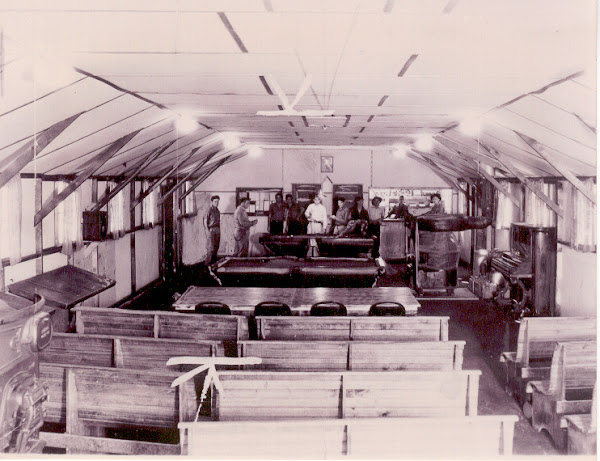
Image Credits: State Map is an edited detail from Cohen's The Tree Army. The photo is also from Cohen and is a view of the recreation room of Camp P-60, home to Veteran's Company 2420, Chatom, Alabama.

Next stop on the State-By-State tour: (The Territory of) Alaska.

Tuesday, January 22, 2008

Important CCC Publications Now Available Online!

An anonymous guest posted a comment regarding two recent web postings that will be of interest to people interested in CCC history and the information is important enough to warrant a specific post.


In a move that will prove both timely and monumental, John Salmond’s The Civilian Conservation Corps, 1933-1942: A New Deal Case Study has been posted online nearly in its entirety (only the index has been omitted).

Salmond’s book is a recognized cornerstone to the structure that is CCC research and scholarship. In the 1960s John Salmond did first what few (if any) have done better: he wrote the life history of the CCC. Admittedly short on the personal narratives seen in so many books and articles today, Salmond’s book is a study of how the CCC came to be and how it grew and evolved, flourished and eventually fell into decline as the U.S. was nudged closer and closer to participation in a world war. Without Salmond’s initial important research and documentation of the program, most of today’s oral history and personal narrative on the CCC would simply be interesting documentation of life experiences, but lacking important context. Though published in 1967, Salmond’s book is very nearly a primary source document for those seeking an organizational history of the Civilian Conservation Corps.

Our anonymous visitor also shared the good news that the U.S. Forest Service history The Forest Service and the Civilian Conservation Corps: 1933-1942 can now be viewed online. Published in 1986, this government publication is especially interesting reading for CCC researchers whose interest is with the work done for the Forest Service. Print copies can be found for sale online and usually run to over $100; having this detailed piece of CCC scholarship available online for free is a huge boon, not simply for people researching the CCC but also for people with a general interest in the U.S. Forest Service.

A huge thank you goes out to our anonymous visitor – we appreciate your help in keeping us up to date on available CCC research material!

John Salmond’s The Civilian Conservation Corps can be viewed and downloaded here:

http://www.nps.gov/history/history/online_books/ccc/salmond/index.htm


The U.S. Forest Service book The Forest Service and the CCC can be viewed and downloaded here: