Showing posts with label Connecticut. Show all posts

Monday, December 24, 2012

Christmas As Reported in the Camp Papers

Each year as Christmas rolls closer, it is difficult not to give some thought to what life must have been like in the CCC camps during the holidays.  Much of what we know about life in the camps during the holidays comes from reports in the individual camp newspapers.

For the enrollees of Company 2704 at Camp SCS-4-M in Chatfield, Minnesota, December 1937 must have been a bittersweet time indeed.  Though Christmas and New Year were looming large on the calendar, so too was the prospect of having to disband the company.  So, while it was printed in hues of green and red, the cover of the Company 2704 camp newspaper for December 1937 didn’t depict an image of Santa Claus or reindeer, but rather a comical image of enrollees loading up their footlockers and barracks bags under the title “Final Edition.”
Nevertheless, whether in honor of the Christmas season or to mark the disbanding of the company, the paper announced that a dinner-smoker event was scheduled and that there would be, “an extra special dinner in the mess hall,” that would be “a second Thanksgiving feast.”

Many enrollees – indeed as many as could afford to and who had leave saved up – left camp to be with relatives.  The December, 1937 Hualpai Echo reported on the plans of some members of Company 1837 at camp SP-8-A near Kingman, Arizona:
Joe Snow, Lloyd Perry and George Edwards left the 16th for a holiday trip to Los Angeles and other points of interest along the Pacific seaboard.  They will return to spend New Year’s Day in camp.
Al Lancaster will spend his Yuletide vacation visiting his family in Tucson.

Manuel Franco, Luis Rios, Quintin Henderson and Joe Lopez will leave the 24th for San Diego where they will spend the holidays visiting relatives – so they say.  They also plan side trips to Tia Juana in Old Mexico and Los Angeles.
The article went on to explain that those enrollees staying in camp could look forward to something special too:

A Christmas Tree with all the trimmings is planned for the men staying in camp (for) Xmas.  A unique way of giving a present to everyone has been worked out.  The climax to the Xmas celebration in camp is the extra-special dinner which will satisfy the gastronic (sic) appetites of all.
At the bottom of the page was included a final admonition:  “Don’t forget a Christmas card to the folks back home…”  Good advice in 1937, good advice today.

Road project (in the snow). Company 1152, N. Stratford New Hampshire. First Corps Area.

Veterans in Company 1826V in the Nogales Sub-District in Arizona reportedly celebrated a quiet and dignified Christmas in camp according to an article in their Company paper:
Christmas at Camp F-30-A was very quietly but appropriately observed.  A large number of men were absent from camp for the weekend but those who were present participated in making Christmas of 1936 a very quiet but dignified occasion.
Judging from the great number of packages and cards, Santa Claus was unusually generous in his plans for the members of Company 1826.  “Merry Christmas” was the password of the company during the holiday season and a good time was had by all.

There seems little question that most camp commanders and technical agency staff worked hard to keep morale high during the holidays.  In her book Gold Medal CCC Company 1538, Kathy Mays Smith recounts the very special Christmas party held for the members of Company 1538 stationed at Camp Wyoming near Pineville, West Virginia in 1935.  The gala event was kept a secret from most of the enrollees right up until they filed into the festively decorated camp recreation hall.  The camp commander addressed the assembled men with greetings of the season before reciting Dickens’ “A Christmas Carol.”  An enrollee choir sang Christmas songs, including “Silent Night,” and three men, directed by an Army lieutenant, acted out a pantomime skit entitled “The Three Wise Men.”  But the high point of the evening came when,

“At last came the climax of the evening.  Instructed to line up in order to sign the payroll, as each one passed the table where the officers stood, he was handed, not a pen and a book full of dotted lines, but a real honest-to-goodness watch, the gift of the Administrative Personnel and Technical Service.”

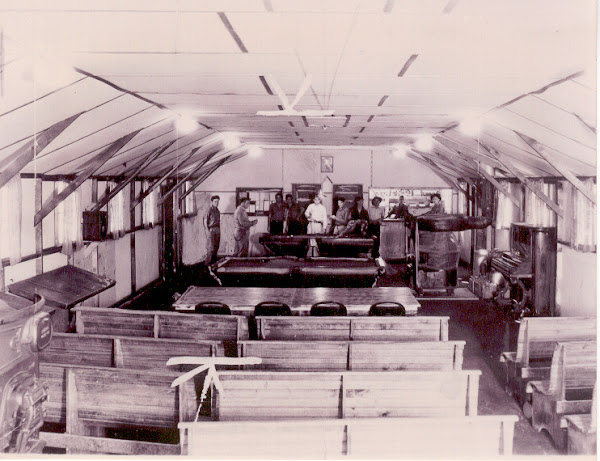
Today it may be difficult to conceive of a time when so many had nothing or nearly nothing; a time when fresh fruit in a Christmas stocking was considered a luxury for some.  Homemade paper decorations and handwritten greetings have given way to brightly colored, electrical powered, mass produced displays made overseas.  However, if we concentrate for a moment and let our mind’s eye open to a vision of the past, we may still catch a glimpse of young men, far from home and family, gathered in a brightly lit mess hall or recreation building in a CCC camp nestled in a western forest, or perched on a ridgeline in an eastern state somewhere.  To be sure, there was sadness – there always is a bit of that; sadness at being away from loved ones perhaps, but the record shows that in the CCC camps there usually was some reason to be thankful and to smile even if that reason now seems so very simple by today’s over inflated standards.  Merry Christmas.
Timber crew on snow shoes. Company 182, West Cornwall, Conn. First Corps Area.


Monday, February 14, 2011

The C.C.C. State-By-State: Connecticut

Before we start, if you’re interested in going back to the initial post in the State-By-State series, click here. You’ll get some notion of the intent of this series and the background on where most of the statistical information is coming from.

Connecticut is a small state and as such the average number of total camps that worked there is small at just 13 according to Merrill in Roosevelt’s Forest Army. In 1937 the total stood at 17 camps, which sorted out thusly: 13 CCC camps were on state forests, 3 CCC camps were on private forests with a single CCC camp assigned to a state park. The existence of these camps meant more than 30,000 Connecticut men received work as a result of the CCC, including some 28,447 junior and veteran enrollees and 2,223 non-enrolled camp personnel.

The 1937 Annual Report of the Director of Emergency Conservation Work includes a state-by-state monthly breakdown of the numbers of enrollees by state. Connecticut’s enrollment for fiscal year 1937 shaped up like this:
July 1936: 3,842
August 1936: 3,571
September 1936: 2,433
October 1936: 3,122
November 1936: 2,891
December 1936: 2,718
January 1937: 3,090
February 1937: 2,907
March 1937: 1,920
April 1937: 2,378
May 1937: 2,143
June 1937: 1,887
Remember that these monthly totals reflect the number of men who enrolled in the CCC in Connecticut on a monthly basis, not the number of enrollees actually working in Connecticut month-to-month.

For the roughly $20.7 million spent on CCC work in Connecticut, the state gained 123 bridges of all types, 9 new lookout towers and over 1,000 acres of public camping and picnic grounds, among other improvements. Also according to Merrill, every CCC camp in Connecticut was named after a prominent person on either the state or national level.

There’s a very interesting point about the CCC buried in Merrill’s description of work in Connecticut. He notes that the Emergency Conservation Work (ECW) law did not make provision for construction of roads, the Forest Service referred to them as “truck trails.” Construction of such “truck trails” would be an important part of CCC work, not just in Connecticut but nationwide.

For a very recent CCC Resource Page post on the CCC at Natchaug, click here. Since that post was made, I’ve found out little about the CCC bridge over the Natchaug River.

Author Marty Podskoch has created a terrific website devoted to the CCC in Connecticut. To see a video of Mr. Podskoch giving a presentation on the CCC in Connecticut, click here.

Perry Merrill’s rundown of CCC work in Connecticut refers to the 1936 dam break above Hartford and the subsequent flooding. Merrill notes that “immediate help by CCC enrollees cleaned out 2,950 buildings and over 800 other structures.”

The 1936 flood was clearly a significant event in Connecticut history and there are ample resources online if you’re interested in more background. Connecticut History Online has a nifty few pages devoted to the flood of 1936 and the Hurricane of 1938. One photo listed with the 1936 flood information is particularly interesting and captivating because the caption purports it to be a photo of National Guardsmen deployed to help with the flood fight. For my money, those look an awful lot like CCC boys. Sadly, the page doesn’t make any reference to the response of the CCC, though there is a reference to the WPA in the section on suggested further reading.

Use the search feature at Connecticut History Online to find two images related to the CCC: an image of Camp Robinson at East Hartford taken in 1935 (who knows, maybe some of those boys helped with flood recovery the next year) and an image of a covered bridge that the CCC helped rebuild. (I’ve cited the copyright data for the photo of the flood response crew used here - above.)

Jump over to Connecticut’s Department of Environmental Protection website to track down a reference to the exact location of Camp Robinson in the Tunxis State Forest.

Connecticut has a museum dedicated to the CCC and to read a terrific blog post about this gem, click here. By all appearances this is a wonderful museum but sadly, I’m unable to find a website dedicated solely to the museum and its collection.

The book Civilian Conservation Corps: A Selectively Annotated Bibliography by Larry N. Sypolt offers up some tantalizing references to both primary and secondary source documents relating to the CCC nationwide and the entries for Connecticut are no exception. Dedicated and resourceful researchers will want to track down Austin Foster Hawes’ article entitled "The C.C.C. Makes Better Men and Forests in Connecticut," published by the State Forester in 1935. Also of interest: Mary E. Pasco’s article “Connecticut Improves Her Trout Streams: Civilian Conservation Corps Inaugurates Pioneer Work in Developing an Important Recreation Asset, published in the February 1934 issue of American Forests.

Connecticut is the smallest state thus far in our State-By-State rundown of work of the CCC across the United States. In looking at the map and searching for data and pictures, I’m reminded of a disparaging argument often made by revisionist historians regarding the CCC. It’s been argued – though less and less lately – that the CCC benefited the western United States to a greater degree than the eastern United States. I’ve always countered that, since most of the public domain is out west, most of the needed work was naturally in the western U.S. Furthermore, I’ve always pointed out that while more work may have been accomplished in the west (where it was most needed – see previous argument), a lot of the enrollees who performed that work out west came from cities, towns and villages in the eastern United States, consequently the allotments sent home to families didn’t end up in western communities but in eastern cities, towns and villages. You just have to look at a map of Connecticut with the ten CCC campsites highlighted to know that there couldn’t have been enough work to sustain a program like the CCC in Connecticut to the same degree it could be kept busy in Wyoming, Montana or California. One might argue that had it not been for the state forest system in the eastern U.S., the CCC would have accomplished little or no forestry work in this region. (In contrast, the vast tracts of USFS acreage in the west created infinite opportunities for the use of CCC labor.) Perhaps this theme is one we’ll revisit as we explore the work of the CCC in other eastern states.
For those of you keeping track, this is state number 7 in the State-By-State series. We'll look at the Delaware next. If you’d like to view a previous entry in the State-By-State series, I’ve added each new state name as a label so that it will be listed in the sidebar, alphabetically along with other labels used in this blog. As always, I look forward to input and hope you’ll post comments if you have something to share or feedback concerning how you found this blog or how you used the information posted here.

Image credits: As with all the State-by-State posts, the state map was taken from a larger map published in Stan Cohen's Tree Army. I simply highlighted the camp locations to make it easier to read. The photo of the flood fighting crew is from the Connecticut Historical Society and the photo of Camp White is from Cohen's Tree Army, where it is credited as a USFS photo.

Monday, December 13, 2010

An Invitation from the Past: Natchaug River Bridge, Connecticut

Thumbing through a three-ring binder from the bookshelf, I came across a neatly folded invitation to a 1934 bridge dedication. In late May 1934, the Honorable Andrew T. J. Clark in Brooklyn, Connecticut was invited to the planned opening of a bridge built across the Natchaug River by the boys of Camp Fernow.

The invitation lists the governor of Connecticut along with the commander of the 3rd Corps area and the director of the US ECW, Robert Fechner as guests of honor. Today I wonder if these esteemed gentlemen did in fact attend the ceremony and I wonder if Mr. Andrew Clark made the journey.

A Google search for images of the bridge yielded nothing. The bridge does receive mention on a Connecticut Department of Environmental Protection website and I’m sad to read that the bridge is no longer deemed safe for vehicle or pedestrian traffic. Perhaps it crumbles away in plain sight of visitors to the Natchaug State Forest. My hope is that the bridge is at least marked with interpretive signage.

Elsewhere on the web you’ll find a personal remembrance of life at Camp Fernow posted at the CCC Legacy website. Former CCC enrollee Bill Beckett writes fondly of his time helping construct the bridge using the simple tools and equipment available at the time – unlike today when cranes and heavy equipment are the norm. He recollects with pride that the bridge is still in use as of his writing in 2009. One has to wonder what has taken place in the last year or so to make forest officials decide to close the bridge. I also wonder if Mr. Beckett was present at the dedication ceremony, standing proudly with his fellow enrollees that day in June 1934. Most certainly there were speeches and, as the invitation states, a tour of the CCC camp. Maybe a lunch was served to guests and visiting dignitaries. It’s important to remember the useful part these dedications and open houses played in the life of the Civilian Conservation Corps. Camps were often filled with young men from out of state and in an era when older residents may have rarely traveled outside their own county, having “outsiders” was a potential disruption that could cause friction if not handled with tact and diplomacy. Thanksgiving and Christmas parties, dances and dedications open to the public were all means of making local residents feel welcome and a useful tool to show folks the value of CCC work in their area. The ceremony to mark the opening of the Natchaug River bridge was no doubt just such an event.

When we think of fall colors, we often think of places like Connecticut and in our mind’s eye there is often a stone bridge mantled in a shroud of red and gold fallen leaves, a crisp cold forest stream coursing below, its waters soon to be frozen as winter nudges closer. That is what I’m thinking of now as I draw the understandable parallel between the lifespan of this stone bridge and the lifespan of the men who built it. They are in the autumn of their years, all of them, and it will fall to those of us who remain to preserve their important work in the form of stone bridges like the one across the Natchaug River on Fernow Road in a scenic corner of Connecticut.