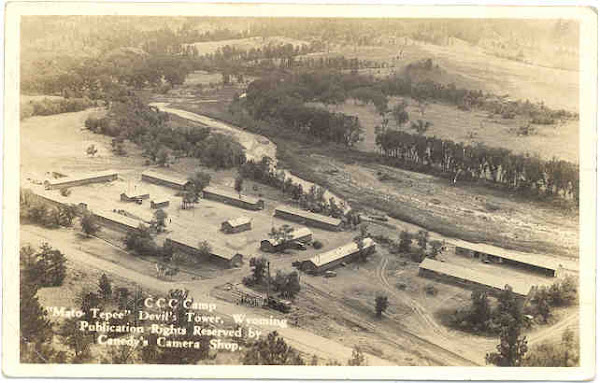
The history of the CCC in Colorado has a very personal feeling for me because it was in Colorado that my grandfather worked as a U.S. Forest Service foreman for the CCC at places like Waunita Hot Spring, Norwood, Delta, Gardner, Idaho Springs, San Isabel and Monument. It was an interest in learning more about grandpa’s work that led me to an interest in the larger history of the CCC.
 So, when I quote Perry Merrill’s statistics regarding the work of the CCC in Colorado, there is a good degree of pride for me in knowing that grandpa helped stack up some of those numbers for the history books. Merrill notes in Roosevelt’s Forest Army that in June 1937 (for example) there were 38 CCC camps in Colorado divided among the technical services thus: 10 National Park Service camps, 10 Soil Conservation Service camps, 6 National Park Service camps, 5 State Park camps, 4 Division of Grazing camps and 3 Bureau of Reclamation camps. My grandpa was among 5,303 camp officers and supervisory staff to work in CCC camps in Colorado that year. Specific work accomplished in Colorado included 577 impounding and large diversion dams, 2,000 miles of truck trails and minor roads and insect pest control on over 3,000,000 acres.
The Annual Report of the Director of Emergency Conservation Work for fiscal year 1937 includes a chart of enrollment numbers divided by state of enrollment. The monthly enrollment numbers for Colorado between July 1936 and June 1937 look like this:
July 1936: 3,428
August 1936: 3,078
September 1936: 2,173
October 1936: 3,249
November 1936: 3,115
December 1936: 2,978
January 1937: 3,805
February 1937: 3,609
March 1937: 2,395
April 1937: 3,264
May 1937: 2,994
June 1937: 2,708
Naturally, forestry work figures prominently in the story of the CCC in Colorado, but other significant CCC projects in the Mile High State include work in Colorado National Monument, Mesa Verde National Monument and in Red Rocks Park outside Denver.
For an exploration of the work of the CCC in Colorado National Monument, visit their online Administrative History – specifically Chapter 4. The December 30, 1933 edition of Happy Days
 reported on the work of CCC enrollees to help in the recovery of 9 Civil Works Administration workers who were killed in a landslide at Colorado National Monument on December 12th. You’ll find a detailed account of the event in the 2008 book With Picks, Shovels and Hope: The CCC and its Legacy on the Colorado Plateau by Wayne K. Hinton and Elizabeth A. Green. Though no CCC enrollees were injured in this tragedy, it is chilling to know that only two days earlier, CCC enrollees had been pulled off that particular part of the project because they lacked the masks required to protect them from the rock dust.
 For a previous CCC Resource Blog post regarding the book New Deal Days: The CCC At Mesa Verde, click here. The work of CCC enrollees at Mesa Verde ran the gamut from tough labor constructing park infrastructure to delicate work constructing dioramas for the museum exhibits.
The CCC Legacy held their annual reunion at Denver's Red Rocks
 Park in 2009. Much of the original camp remains, in part because it was quickly occupied by the military shortly after its stint as a CCC camp was complete. There is an impressive exhibit in the amphitheatre visitor center that includes terrific photos of the work done by enrollees from camp SP-13-C. The main exhibit panel reads in part:
Red Rocks Amphitheatre was the Civilian Conservation Corps’ largest and most ambitious project. A crew of about 300 young men at any one time lived in barracks near Morrison and worked on the theatre from 1936 to 1941, with help from the National Parks Service and Works Progress Administration. They laid 10 boxcar loads of cement and put down 90,000 square feet of flagstone quarried at Lyons, Colorado. The physical structure of the facility, as well as all the finished terracing and stonework, was built by hand, without the help of any machines.

On a personal level, I’ve explored more of the history of the CCC in Colorado than perhaps any other state with the possible exception of Arizona. Most of what I have learned has come as a result of searching for information on the camps where my grandfather, William “Bill” Rutherford worked as a U.S. Forest Service foreman. Along the way, I learned a lot of other stuff about what the CCC did in Colorado.

On a personal level, I’ve explored more of the history of the CCC in Colorado than perhaps any other state with the possible exception of Arizona. Most of what I have learned has come as a result of searching for information on the camps where my grandfather, William “Bill” Rutherford worked as a U.S. Forest Service foreman. Along the way, I learned a lot of other stuff about what the CCC did in Colorado.
There is perhaps no greater primary source document on the CCC in Colorado than the book History of Civilian Conservation Corps in Colorado, Summer 1936, which is basically a District
 Annual or yearbook that gives details on all the CCC camps working in what were then called the Littleton District and the Grand Junction District. And while the book is a treasure to folks looking for details on CCC companies in Colorado, it’s also a boon for anyone looking for histories of CCC companies that were formed in or worked in the 8th Corps Area because it contains a list of individual company histories, giving their mobilization date and location and the places they worked. (Admittedly, there are discrepancies in some individual histories when they are compared to information gathered through detailed research, but if you’re seeking information on a company that worked in Colorado, you can’t do any better than starting here. I’ll post scans of those pages here at the bottom of this post for your reference.)
I’ll close this entry in the State-By-State series by sharing the text of a memorandum that was posted at the Red Rocks CCC camp outside Denver in 1937. In welcoming new and visiting enrollees, I don’t think Lieutenant Neely could have done any better in his choice of encouraging words; they’re a decent set of guidelines even today.
August 2, 1937
Company Memorandum:
For the information of all New Enrollees and Enrollees on detached service with this company, the following is issued for your guidance.
You are welcome.
1. The camp policy is, “A square deal to all.”
2. We have but few rules – observe them.
3. Your problem is our problem.
4. This is your camp; be proud of it.
5. Cooperation and getting along is our Motto.
6. Your health and comfort are our chief concern.
7. Recreation is considered necessary.
8. Your privacy and rights are respected.
9. Respect the privacy and rights of all hands.
10. Help us maintain clean Barracks, clean Grounds and a smart appearance.
11. The Camp Commander always has time for your “Problem”.
Signed: H.W. Neely, 1st Lt. USNR, Commanding
+ + +
Some 75 years later I believe Lieutenant Neely's philosophy lived in the form of many enrollees, camp staff, overhead and military officers and their daily dealings with their fellowmen and I'm proud to let the record show that my grandfather William Rutherford was one of them
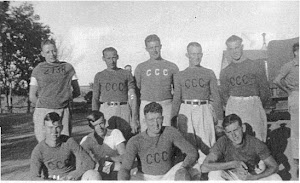
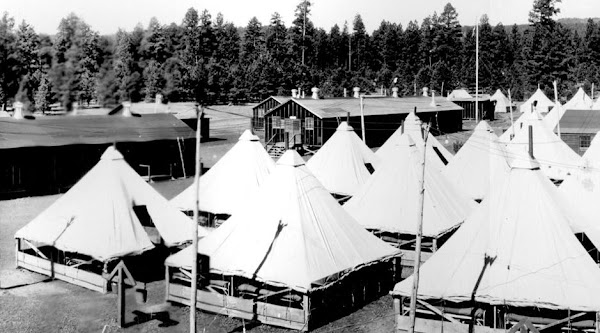
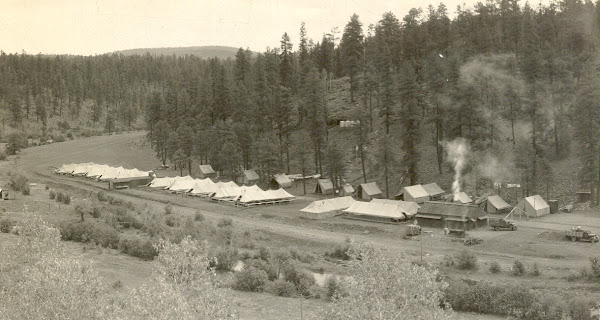
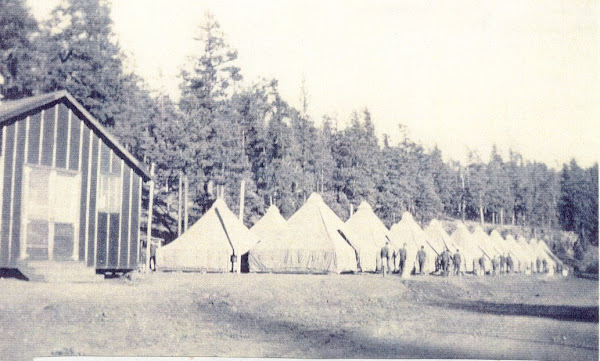
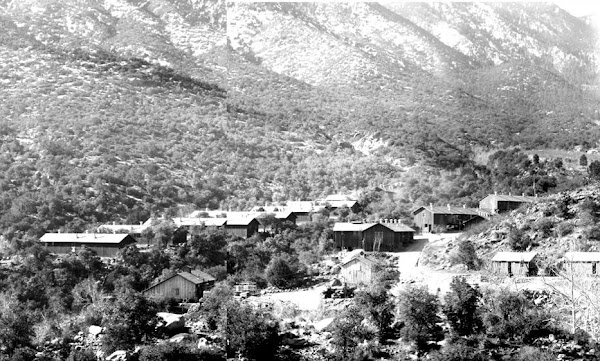
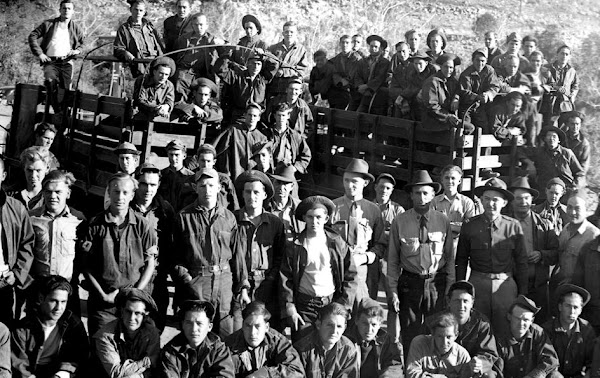
 (above) Foreman Bill Rutherford with his crew, Norwood, Colorado. (below) the CCC camp at Idaho Springs, Colorado.
(below)Individual Company histories from the 1936 Colorado District Annual:


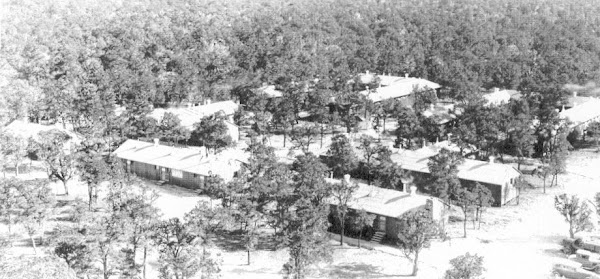
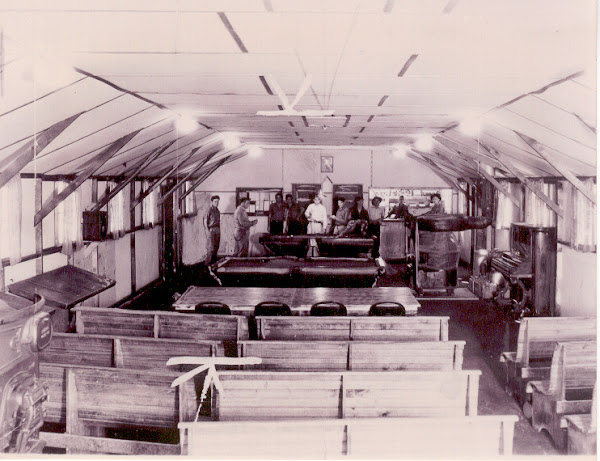
 (Sources: The Colorado state map is taken from Cohen's Tree Army. Images from Colorado National Monument and Mesa Verde are from the book With Picks, Shovels and Hope. The contemporary image of the camp at Morrison, Colorado and the text of Lt. Neely's letter are from the Red Rocks visitor center exhibit. The company histories were taken from the 1936 District Annual. The image of the Idaho Springs CCC camp is from the Colorado State Archives, item number 30255 FF-6.)