Showing posts with label Books. Show all posts

Monday, January 27, 2014

Thank you, John Salmond


For anyone who makes even a passing study of the subject, the arc of Civilian Conservation Corps history swings right through John A Salmond’s book The Civilian Conservation Corps, 1933-1942: A New Deal Case Study.  Open any scholarly work on the subject of the CCC and odds are good you’ll see Salmond listed in the notes.  I refer to Salmond’s book nearly every time I fire up the computer to write and I have done so for more than 20 years.

Occasionally I will conduct an internet search for Dr. Salmond and it was in this way that I contacted him by email back in early 2006.  In a gracious response to a stranger’s email from overseas Dr. Salmond expressed surprise over the long-running success of his book, writing, “…it has always surprised me that my little book, now long out of print, remains the standard work on the Corps.”  To my great surprise and satisfaction, Dr. Salmond also agreed to help me with my CCC writing efforts, including the book on which it seems I have been “working” for years.  Sadly, while I remain optimistic that I will actually complete my own book on the Civilian Conservation Corps, John Salmond will definitely not be writing the forward for that book as I had originally hoped.

Last week, during one of my occasional internet searches for “John A. Salmond,” I found a La Trobe University tribute to the late professor, which you can view here.   It seems Dr. Salmond passed away last summer.

It is no exaggeration to say that John Salmond’s work is the foundation upon which some 40 odd years of Civilian Conservation Corps scholarship rests.  When a historian, scholar or freelance researcher works on CCC history, they stand on John Salmond’s shoulders.  My interest in the CCC was fired initially by my grandfather’s work for the Forest Service in the 1930s but my ongoing work and research of the CCC has been propelled forward because, early on, in an Arizona State University library, I discovered John A. Salmond’s valuable contribution to the study of our beloved Civilian Conservation Corps.  Godspeed, Dr. Salmond, and thank you.

Photo of John A. Salmond is from the La Trobe University website.  Image of the book cover, from the author’s collection.

©Michael I. Smith, 2014

Monday, March 14, 2011

The C.C.C. State-By-State: A Progress Update

One-Fifth of the Way There
With last week’s posting of the Florida entry in the State-By-State series, we’re roughly 1/5th of the way through the U.S. states and territories. Now might be a good time for me to catch my breath, perhaps update the stated goals and purpose of the series and this may be a good opportunity to point out some changes that have already been made to the individual state entries already posted.

Statistics, Personal Narratives and Illustrations
Initially, I’d made it clear that I planned to rely heavily on the individual summaries of state CCC work found in Perry Merrill’s book Roosevelt’s Forest Army and I’ve done so. However as the postings have progressed, I’ve found that three Annual Reports in my collection are serving as a very useful set of source materials to supplement Merrill’s snapshot of state work. This has had the effect of making the posts a bit heavy on numerical statistics and lighter on individual camp accomplishments, which may not be a benefit to the casual reader, however I’m hoping that the more detailed camp totals, work statistics and enrollment numbers represent data that is largely unavailable to local researchers – especially to high school and undergraduate students – who may be seeking obscure statistical data for papers, reports or presentations. The sort of information that may be boring to most readers will be a boon to the occasional scholar who seeks to include such details in their work. As an extension of this, if you are a scholar who is doing research and you’d like to have scanned images from the Annual Reports that I cite in the State-By-State series, post a comment and let me know how to reach you and I’ll gladly do what I can to get the information to you. (I wouldn’t have called this a “resource” page if I hadn’t intended to share useful – if sometimes mundane – information.)

Another benefit to using numbers from the Annual Reports as companion data for the project information in Roosevelt’s Forest Army has been the ability to compare Merrill’s “snapshot” of CCC work against the “snapshot” of work shown in the annual reports for 1937, 1939 and to a lesser degree, 1942. The comparisons aren’t meant to validate or discredit Merrill’s numbers, but more to show trends in the program between 1933 and 1942. Merrill’s state work summaries typically list an average number of camps in a state, where the Annual Reports for 1937 and 1939 provide a more detailed breakdown of the camp totals for their respective fiscal year. An average is useful, but I hope that researchers will find it’s also useful to know if the totals for 1937 and 1939 are above or below the average cited by Merrill.

To offset some of the heavily statistical information in the individual posts, I’m working to include personal histories of CCC enrollees whenever possible, and will go back to add those personal histories to the state’s already posted when necessary. One great source of these personal narratives has been the book Youth Rebuilds, which was published in 1934. I’m also throwing in data on selected cases of CCC fatalities in each state as they become available.

Something else that I’ve found as I’ve worked through the first 10 state articles is that photographs aren’t always easily accessible or those photos that may be available are covered in copyright restrictions. I’m not in the habit of pirating images from other sites, so more than likely you’ll find that I include links to sites that have useful or interesting photos of CCC work in particular states, rather than lifting the images from those sites for use here at the CCC Resource Page. Ultimately, visitors here will have to choose whether or not they choose to use images found on linked sites. This issue has become more important to me lately, as I’ve seen some of my own work and images used on other sites without a proper citation (to say nothing of the fact that the user took the material without asking first). With this in mind, visitors here need to keep me honest, too. If you see images or references not properly cited or credited here at the CCC Resource Page, please post a comment explaining the problem so that I can remedy the situation.

Updates to Past Posts
Since starting the State-By-State series at the first of the year, I’ve revised just two entries: Alabama and Arkansas. The Alabama entry was updated to include more information regarding Robert Pasquill’s book The Civilian Conservation Corps in Alabama – specifically its lack of detailed references to racism in the CCC. The Arkansas entry was updated to include a better explanation of monthly enrollment figures. Additionally, I added a brief discussion of racism in the selection and deployment of black enrollees in Arkansas. In both cases, the new information on racism grew out of a post I did in honor of Black History Month over at the Forest Army blog.

To date, roughly two and a half months into this project, I’ve not had any comments posted regarding the State-By-State series, however it seems that visitor hits are higher lately on average. Please, if you enjoy something you see here, if something was especially helpful to you in your research, if you have questions or need greater detail, or if you wish to offer constructive criticism, please leave a comment and if you need more information, make sure there’s some way I can contact you. My goal with this blog is to create a resource for CCC researchers of all ages, to help grade schoolers, high schoolers and college scholars in their search for information on the Civilian Conservation Corps.


Monday, February 21, 2011

The C.C.C. State-By-State: Delaware

The state of Delaware was situated in the 2nd Corps area along with New Jersey and New York. In Roosevelt’s Forest Army, hidden about halfway through his rundown of CCC work in Delaware, Perry Merrill tosses out a unique factoid that sets Delaware apart from all other states and territories. Basically, Merrill notes that Delaware was the last state to get CCC camps. Evidently, the purchase of just over 1,000 acres for the Redden State Forest cleared the way for establishment of CCC camps so the first Delaware camp wasn’t established until October 1933 during the second enrollment period. That first camp, Camp S-53-D was quickly occupied by Company 2233V, company of World War I veterans who were moved from a project in nearby Vermont. So, while the total available information about the CCC in Delaware may be limited, there will always be that one interesting statistic: Delaware was the last state to have CCC camps.

(Now, here’s a question to ponder. It has long been thought that CCC camps were numbered in the order that they were established within each state. Thus, the first camp to be established in Delaware would be S-1-D, or so one would assume. Why was Delaware’s first camp numbered “53”? I’ve no idea but thought it would be an interesting question to toss out there.)

The State of Delaware has a scanned image of typewritten song lyrics penned by an enrollee at a CCC camp in Lewes, Delaware. The website notes that Delaware’s CCC camps were located in Lewes, Magnolia, Leipsic, Georgetown, Slaughter Beach, Frederica and Wyoming and that one of the main projects of the CCC was construction of drainage ditches for mosquito control.

There is one blog entry about the CCC at the State of Delaware’s blog site and you can view it here. It’s a neat little piece about mosquito control.

Merrill notes that the maximum number of CCC camps to operate in Delaware was 8 and that all but one (the aforementioned Camp S-53-D) were soil conservation and mosquito control camps. Even for its small size, an average of 5,382 Delaware men were given employment because of the CCC.

If we compare Merrill’s camp total against the Annual Reports for fiscal years 1937 and 1939 we find that between July 1936 and June 1937 Delaware had 1 state forest camp, 4 mosquito control camps, 2 agricultural engineering camps and 1 military reservation camp for a total of 8 camps. For the same period between 1938 and 1939 Delaware only had 4 CCC camps, broken out as follows: 1 state forest camp, 1 biological survey camp, and 2 agricultural engineering camps.

Delaware’s overall specific project totals (cited in Merrill’s Forest Army) include:
Trees Planted: 274,000
Channel Cleaning/Flood Control: 12,682,774 square yards
Forest Stand Improvement: 692 acres
Mosquito Control: 52,874 acres

In the state forests of Delaware, CCC enrollees worked at establishing forest boundaries through surveying and marking, construction of truck trails, timber salvage, collection of seedlings, reducing fire hazards and reforestation. A section of forest called the Red Lion Tract was donated to the state of Delaware in 1930, but it wasn’t until the arrival of the CCC that work was begun to reforest the acreage with loblolly pine, shortleaf pine and Scotch pine.

The Annual Report of the Director of Emergency Conservation Work for fiscal year 1937 lists the monthly totals for enrollment in Delaware as follows:
July 1936: 485
August 1936: 437
September 1936: 336
October 1936: 405
November 1936: 387
December 1936: 369
January 1937: 421
February 1937: 408
March 1937: 319
April 1937: 334
May 1937: 285
June 1937: 254
These monthly totals reflect the number of young men who enrolled in the state of Delaware, not the total number of CCC boys working in the state of Deleware.

If we drill down a bit deeper into the state-by-state numbers in the 1937 Annual Report we’ll find that Delaware gained the following improvements between July of 1936 and June of 1937:
Vehicle bridges: 2
Sewer lines: 1,183 linear feet
Field planting/seeding: 33 acres
Fire hazard reduction (“Road & Trailside”): 6.7 miles
Fire hazard reduction (“Other”): 293.0 Acres
Mosquito control: 7,234 man days

The CCC Legacy maintains a camp listing and the entry for Delaware is reasonably short. The CCC Legacy list shows the following companies operated in Delaware on the dates indicated:
Co. 1224, November 1933 at Lewes, DE, Camp P-51
Co. 1224, April 1936 at Lewes, DE Camp MC-51
Co. 1226, November 1933 at Milford, DE, Camp P-51
Co. 1226, April 1936 at Milford, DE, Camp MC-52
Co. 1293, January 1936 at Georgetown, DE, Camp S-53
Co. 1295, July 1935 at Dover, DE, Camp MC-54
Co. 2213V, July, 1935 at Ft. DuPont, DE, Camp Army-1
Co. 3220, September 1935 at Georgetown, DE, Camp D-2/SCS-2
Co. 3221, October 1935 at Clayton, DE, Camp MC-55
Co. 3222, October 1935 at Wyoming, DE, Camp D-1
Co. 3269C, April 1938 at Dover, DE, Camp BS-1

The camp/company listings at the CCC Legacy website are simply representative and have been taken from the various camp strength listings for dates throughout the lifespan of the CCC.

The February 3, 1940 issue of Happy Days reported the death of a Delaware CCC enrollee from Company 3220, hit by an automobile. The microfilm image is poor; his first name was Dante and his last name looks like Corbyons.

The map image was taken from Stan Cohen's The Tree Army and highlights added to make it easier to read. To read the initial entry in the State-By-State series, click here.

Monday, February 7, 2011

The C.C.C. State-By-State: Colorado

The history of the CCC in Colorado has a very personal feeling for me because it was in Colorado that my grandfather worked as a U.S. Forest Service foreman for the CCC at places like Waunita Hot Spring, Norwood, Delta, Gardner, Idaho Springs, San Isabel and Monument. It was an interest in learning more about grandpa’s work that led me to an interest in the larger history of the CCC.

So, when I quote Perry Merrill’s statistics regarding the work of the CCC in Colorado, there is a good degree of pride for me in knowing that grandpa helped stack up some of those numbers for the history books. Merrill notes in Roosevelt’s Forest Army that in June 1937 (for example) there were 38 CCC camps in Colorado divided among the technical services thus: 10 National Park Service camps, 10 Soil Conservation Service camps, 6 National Park Service camps, 5 State Park camps, 4 Division of Grazing camps and 3 Bureau of Reclamation camps. My grandpa was among 5,303 camp officers and supervisory staff to work in CCC camps in Colorado that year. Specific work accomplished in Colorado included 577 impounding and large diversion dams, 2,000 miles of truck trails and minor roads and insect pest control on over 3,000,000 acres.

The Annual Report of the Director of Emergency Conservation Work for fiscal year 1937 includes a chart of enrollment numbers divided by state of enrollment. The monthly enrollment numbers for Colorado between July 1936 and June 1937 look like this:
July 1936: 3,428
August 1936: 3,078
September 1936: 2,173
October 1936: 3,249
November 1936: 3,115
December 1936: 2,978
January 1937: 3,805
February 1937: 3,609
March 1937: 2,395
April 1937: 3,264
May 1937: 2,994
June 1937: 2,708

Naturally, forestry work figures prominently in the story of the CCC in Colorado, but other significant CCC projects in the Mile High State include work in Colorado National Monument, Mesa Verde National Monument and in Red Rocks Park outside Denver.

For an exploration of the work of the CCC in Colorado National Monument, visit their online Administrative History – specifically Chapter 4. The December 30, 1933 edition of Happy Days reported on the work of CCC enrollees to help in the recovery of 9 Civil Works Administration workers who were killed in a landslide at Colorado National Monument on December 12th. You’ll find a detailed account of the event in the 2008 book With Picks, Shovels and Hope: The CCC and its Legacy on the Colorado Plateau by Wayne K. Hinton and Elizabeth A. Green. Though no CCC enrollees were injured in this tragedy, it is chilling to know that only two days earlier, CCC enrollees had been pulled off that particular part of the project because they lacked the masks required to protect them from the rock dust.

For a previous CCC Resource Blog post regarding the book New Deal Days: The CCC At Mesa Verde, click here. The work of CCC enrollees at Mesa Verde ran the gamut from tough labor constructing park infrastructure to delicate work constructing dioramas for the museum exhibits.

The CCC Legacy held their annual reunion at Denver's Red Rocks Park in 2009. Much of the original camp remains, in part because it was quickly occupied by the military shortly after its stint as a CCC camp was complete. There is an impressive exhibit in the amphitheatre visitor center that includes terrific photos of the work done by enrollees from camp SP-13-C. The main exhibit panel reads in part:

Red Rocks Amphitheatre was the Civilian Conservation Corps’ largest and most ambitious project. A crew of about 300 young men at any one time lived in barracks near Morrison and worked on the theatre from 1936 to 1941, with help from the National Parks Service and Works Progress Administration. They laid 10 boxcar loads of cement and put down 90,000 square feet of flagstone quarried at Lyons, Colorado. The physical structure of the facility, as well as all the finished terracing and stonework, was built by hand, without the help of any machines.

On a personal level, I’ve explored more of the history of the CCC in Colorado than perhaps any other state with the possible exception of Arizona. Most of what I have learned has come as a result of searching for information on the camps where my grandfather, William “Bill” Rutherford worked as a U.S. Forest Service foreman. Along the way, I learned a lot of other stuff about what the CCC did in Colorado.

There is perhaps no greater primary source document on the CCC in Colorado than the book History of Civilian Conservation Corps in Colorado, Summer 1936, which is basically a District Annual or yearbook that gives details on all the CCC camps working in what were then called the Littleton District and the Grand Junction District. And while the book is a treasure to folks looking for details on CCC companies in Colorado, it’s also a boon for anyone looking for histories of CCC companies that were formed in or worked in the 8th Corps Area because it contains a list of individual company histories, giving their mobilization date and location and the places they worked. (Admittedly, there are discrepancies in some individual histories when they are compared to information gathered through detailed research, but if you’re seeking information on a company that worked in Colorado, you can’t do any better than starting here. I’ll post scans of those pages here at the bottom of this post for your reference.)

I’ll close this entry in the State-By-State series by sharing the text of a memorandum that was posted at the Red Rocks CCC camp outside Denver in 1937. In welcoming new and visiting enrollees, I don’t think Lieutenant Neely could have done any better in his choice of encouraging words; they’re a decent set of guidelines even today.

August 2, 1937
Company Memorandum:
For the information of all New Enrollees and Enrollees on detached service with this company, the following is issued for your guidance.
You are welcome.
1. The camp policy is, “A square deal to all.”
2. We have but few rules – observe them.
3. Your problem is our problem.
4. This is your camp; be proud of it.
5. Cooperation and getting along is our Motto.
6. Your health and comfort are our chief concern.
7. Recreation is considered necessary.
8. Your privacy and rights are respected.
9. Respect the privacy and rights of all hands.
10. Help us maintain clean Barracks, clean Grounds and a smart appearance.
11. The Camp Commander always has time for your “Problem”.
Signed: H.W. Neely, 1st Lt. USNR, Commanding
+ + +
Some 75 years later I believe Lieutenant Neely's philosophy lived in the form of many enrollees, camp staff, overhead and military officers and their daily dealings with their fellowmen and I'm proud to let the record show that my grandfather William Rutherford was one of them

(above) Foreman Bill Rutherford with his crew, Norwood, Colorado. (below) the CCC camp at Idaho Springs, Colorado.

(below)Individual Company histories from the 1936 Colorado District Annual:

(Sources: The Colorado state map is taken from Cohen's Tree Army. Images from Colorado National Monument and Mesa Verde are from the book With Picks, Shovels and Hope. The contemporary image of the camp at Morrison, Colorado and the text of Lt. Neely's letter are from the Red Rocks visitor center exhibit. The company histories were taken from the 1936 District Annual. The image of the Idaho Springs CCC camp is from the Colorado State Archives, item number 30255 FF-6.)

Tuesday, January 18, 2011

The C.C.C. State-By-State: Arizona

This marks the third state entry in the State-By-State series. If you’d like to get some background on the purpose and scope of this series, you can read the initial entry in the State-By-State series by clicking here. Over time, there may be a need to go back and revise the individual state entries in order to add new information or correct the information that is already posted, so if you’re interested in a particular state, be sure to check back from time to time to see if there are any updates.

Arizona is another state for which there has been some worthwhile and very useful CCC research done in the not too distant past, most notably Robert Moore’s book on the CCC in Arizona’s Rim Country, which we’ll touch on in a moment.

First, let’s start with some statistics from Perry Merrill’s book Roosevelt’s Forest Army. Merrill notes that the number of individual camps in the state of Arizona numbered about fifty and that the aggregate number of Arizona men who were given work as a result of the CCC stands at 41,363. Between 1933 and 1942, CCC enrollees in Arizona strung 3,559 miles of telephone lines, built 512,093 erosion control check dams and planted an astounding 7.4 million trees! Merrill also briefly notes the work of the CCC in Phoenix, Tucson, Colossal Cave and the Hualpai Mountains though an error in the text makes it seem that the Hualapai Mountains are in or near Tucson, when in fact they are in the opposite corner of the state, near Kingman, Arizona. (You’ll also note the various spellings of “Hualapai”.)

For many years and importantly during the Great Depression, Arizona had a wonderful advocate in the person of Senator Carl Hayden. To read about the creation of the CCC camps at Phoenix South Mountain Park – including Senator Hayden’s role in the effort – click on my previous post about the CCC at South Mountain Park. It is safe to say that were it not for Senator Hayden, Phoenix would not have gotten at least two of the CCC camps that it was allotted during the 1930s. One can only imagine what other help Senator Hayden provided to insure the success of the CCC in Arizona.

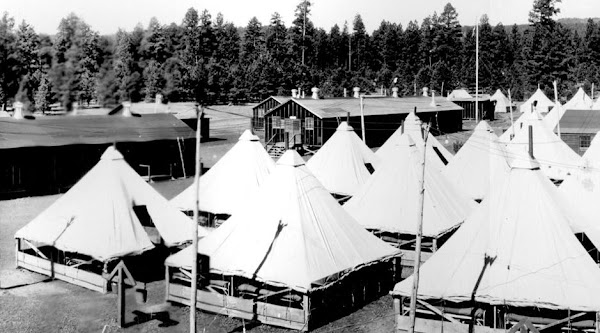
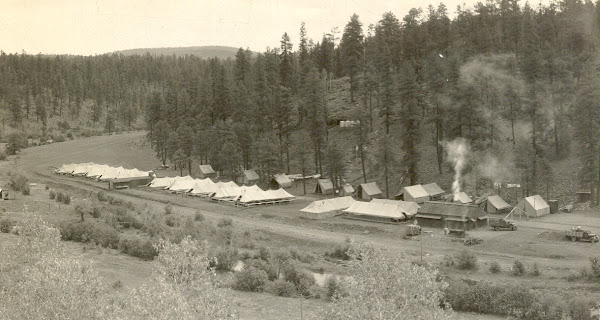
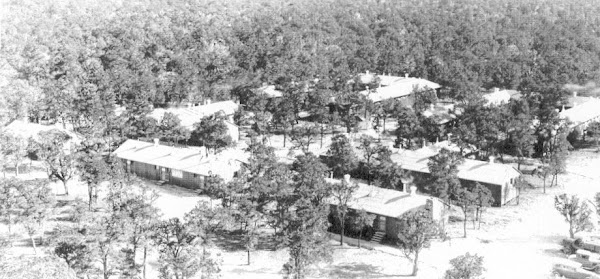
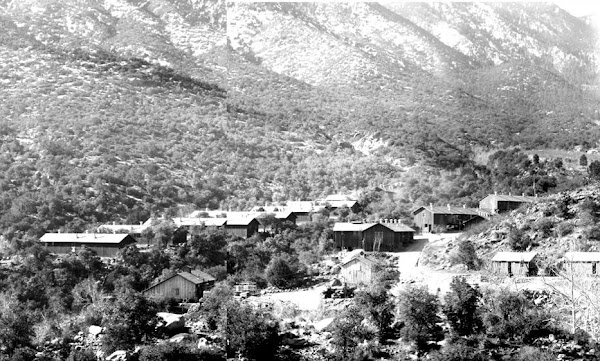
The CCC also worked at Papago Park, another park located in the Phoenix metropolitan area. Lesser known though vaguely referenced in Roosevelt’s Forest Army, is the work at Hualapai Mountain Park near Kingman, Arizona. You can see an all too brief history of the park by clicking on the Mojave County Parks website here. The 1936 Phoenix District Annual reported that at that time Company 1837 was working at camp SP-8-A in the “Hualpai” Mountains. Prior to arriving near Kingman, Company 1837 worked at SP-1-A in Randolph Park near Tucson and then camp SP-6-A in Tucson’s Rincon Mountains. (The black and white photos of SP-8-A in this post are from that 1936 District Annual.) Given the fact that the place owes its existence to the CCC, more could be done to document and report on the work of the CCC at Hualapai Mountain Park.

A thumbnail sketch of the places where the CCC worked in Arizona would look something like this:
Multiple improvements like roads, ramadas and lookout structures at both Phoenix South Mountain Park and Papago Park, infrastructure and aesthetic improvements at Grand Canyon, both on the North and South Rims and down in the Canyon. Additionally, upgrades and improvements to the irrigation system in the metro Phoenix area and in the area around Yuma, erosion control work throughout the state, significant improvements at Colossal Cave and Chiricahua National Monument in southeastern Arizona, immeasurable improvements to the forest lands across the state and work at Petrified Forest.

Two books come to mind when discussing the work of the CCC in Arizona: Louis Lester Purvis’ wonderful book The Ace in the Hole: A Brief History of Company 818 of the Civilian Conservation Corps (1989) and Robert J. Moore’s more recent, more scholarly book The Civilian Conservation Corps in Arizona’s Rim Country: Working in the Woods (2006). Purvis’ book on the work of the CCC at Grand Canyon stands head and shoulders above other Arizona-related works because it is the only published text that is a personal narrative penned by a CCC veteran who worked in Arizona and I’ve been remiss in not posting a detailed review of it here or at the Forest Army blog. To read an earlier posting I did for Moore’s book, over at Forest Army click here. Bottom line: If you’re doing research on the work of the CCC in Arizona, these two books will be an important resource for you.

Other equally important if less in-depth coverage of CCC work in Arizona can be found in Sharon Hunt’s Images of America book entitled Vail and Colossal Cave Mountain Park and Donna and George Hartz’s Images of America book entitled The Phoenix Area’s Parks and Preserves, both published by Arcadia Publishing. (Any time to encounter an Arcadia Publishing Images of America title, be sure to scan through it for images and references to the CCC – you’ll be surprised at how often these titles include references to work done by the Forest Army during the 1930s.) Elsewhere, you’ll find references to the CCC in Letters from Wupatki by Courtney Reeder Jones and Bradford Luckingham’s Phoenix: A History of a Southwestern Metropolis. (Admittedly, the single reference to the CCC in Luckingham is a bit thin but the book also provides useful insight into life in Phoenix during the New Deal era.)

To view all of the Arizona-related posts over at the Forest Army blog, click here.

Interest in the work of the CCC in Arizona remains strong and the Arizona State Archives now maintains a set of all available issues of the CCC newspaper Happy Days on microfilm.

The map for this post (as with all maps used thus far) comes from a map of camp locations published in Cohen’s The Tree Army. The color photo of the CCC-built cabin comes from the Mojave County Parks website and the black and white images of the CCC camp at Hualpai Mountain Park are from the 1936 Phoenix District Annual.

Friday, December 11, 2009

New Deal Days: The CCC at Mesa Verde

New Deal Days: The CCC at Mesa Verde by Ronald C. Brown and Duane A. Smith, published by the Durango Herald Small Press in 2006 as part of the Mesa Verde Centennial Series, is a tidy account of the accomplishments of the CCC at Mesa Verde in southwestern Colorado.

Although the book is somewhat short, the author’s have wisely chosen to keep their discussion and analysis of the creation and general history of the CCC relatively brief, thus giving over more space for the terrific story of the CCC history at Mesa Verde National Park. After all, most folks who consider picking up a book of this sort will likely have come to understand the situation in the United States in 1933 when the first CCC enrollees arrived at Prater Canyon to occupy a camp that can only accurately be characterized as “rustic.”

Brown and Smith provide wonderful snippets of camp life, drawing on personal accounts from enrollees who were at Mesa Verde as well as official records and camp newspaper accounts of activities. From the rigors of working on a bug crew to swapping out the carburetor jets on the trucks, even seemingly mundane tasks associated with life in the CCC camps are worthy of mention in the text. And, while CCC work was “labor intensive and characteristically unglamorous,” it seems the enrollees could always make time for taking potshots at a bobcat with a “bean shooter” or for dumping a local jail building in the river!

Also noteworthy are the more than 35 photos that illustrate the text as well as the walking tour of CCC projects that is included near the end of the book. (The walking tour was written by Don Ross.) Also, for those with a particular interest in camp architecture, there is a terrific section entitled “Architecture, Design and Construction of CCC Camps at Mesa Verde” written by Susana M. Jones also included in the text.

You can see (and purchase) the New Deal Days at the publisher’s website Here.

Be sure to visit the Mesa Verde Museum Association website.


At roughly 130 pages in length a book of this size leaves you wondering what else there might be to uncover. (For example, what were the exact details regarding the jail and its dip into the river?) Nevertheless, this book is still another required addition for anyone hoping to compile a library of meaningful CCC books and with a cover price that is altogether reasonable, there really isn’t any excuse to pass this one up.

Monday, June 29, 2009

The Colorado Whoopenhollars: Living a Good Life Despite the Great Depression

If we look deep enough and consider all that was happening during the 1930s, it becomes clear that one of the primary accomplishments – if not a goal stated outright - of the CCC was the preservation of families and family livelihoods.

Remember that enrollees were required to send all but a few dollars of their $30 monthly pay home to their needy family. FDR and his advisors realized that money accumulating in an enrollee’s footlocker, deep in some forest in Arkansas or Colorado, wouldn’t do the economy much good. For thousands of families, that additional $25 meant the difference between paying the rent and being tossed into the street. The allotment sent home by a son meant food on the table.

While we’ll never know every CCC enrollee story, we’ve got a good grasp of camp life and the work that went into insuring that the family received the monthly allotment. But what of those who remained at home while the young enrollee shipped out to work in a park or forest far from home? We have some of that story through the eyes of the enrollees themselves because they’ve often told of how important that monthly allotment was to their parents or loved ones. But what about the families of the men who ran the CCC camps? What about the foremen and supervisors from the National Park Service, the Bureau of Reclamation and the U.S. Forest Service? What did the creation of the CCC mean to their families?

The Colorado Whoopenhollars, a newly released book offers a glimpse of what it was like to be waiting at home while a father is far away working as a supervisor in the forestry camps of the CCC. The full title of the book is The Colorado Whoopenhollars: Living a Good Life Despite the Great Depression and in it the reader is transported back to a small Colorado town in the 1930s. Through personal recollections, letters and the shared memories and experiences of her four brothers Jean Rutherford Duaine provides a close look at small town life during the Great Depression and just as importantly, she offers an insight into how a father coped with the long months of forestry work that kept him from his wife and small children.

The first section of the book is literally a guided tour of Georgetown, Colorado as the author remembers it from the 1930s. We’re introduced to an extended but tight knit family struggling to look after each other in the midst of a national economic crisis. In addition to siblings, parents, grandparents and uncles, we meet friends and neighbors from town – many of whom are as close as family. Woven through this narrative is the continual longing of a youngster for her daddy, William Rutherford, who is miles and miles away working for the U.S. Forest Service.

The latter portion of the book contains the texts of the letters that Bill Rutherford wrote to his children during his long absences; but these aren’t really just letters, they’re the story of five youngsters – the Whoopenhollar kids (named Billy, Frank, John, Jean and Glenn after Rutherford’s own children) and their hair raising adventures in the wilds of the Rocky Mountains. A careful reader will come to realize that a longing for loved ones burned in the heart of both the family at home and the forest ranger working in the forest camp far from home.

Part family history, part historical record, part children’s story, The Colorado Whoopenhollars will appeal to readers of all ages. Moreover, despite the national desperation and hardship of those times, the story is upbeat and full of the author’s love of a special time and place.

While not directly related to the Civilian Conservation Corps, The Colorado Whoopenhollars offers a rare look at how the families of this era coped with the long absences of sons, brothers, husbands and fathers while they were away working in the CCC. More importantly perhaps, the book offers a glimpse at one father’s heart warming effort to remain connected to his kids back home.

For more information visit:

The Official Colorado Whoopenhollar website

Disclaimer:Jean Rutherford Duaine is my mom. I couldn’t be more proud of her for writing this book and my enthusiasm probably makes me a biased source but there you have it.

Tuesday, August 14, 2007

Books About the CCC

This list isn't in any particular order and isn't all-inclusive, but it should start you off in the right direction in your CCC research. This blog isn't intended as a way to sell books. You should be able to obtain copies of some of these books at your local library. Other books, especially the government publications can be hard to locate and an interlibrary loan may be needed if you decide you want to obtain a copy of the book in question.

Without question one of the single best books on the CCC is John Salmond's book subtitled "A New Deal Case Study," which is long out of print but which can be borrowed at local libraries and at ASU. Check back occasionally to see if new source material has been added to this list.

Louis Lester Purvis, The Ace in the Hole: A Brief History of Company 818 of the Civilian Conservation Corps (Columbus, GA: Brentwood Christian Press, 1989)

Alfred Emile Cornebise, The CCC Chronicles: Camp Newspapers of the Civilian Conservation Corps, 1933-1942 (Jefferson, NC: McFarland & Co. 2004)

John A. Salmond, The Civilian Conservation Corps, 1933-1942: A New Deal Case Study (Durham: Duke UP, 1967)

Peggy Sanders, The Civilian Conservation Corps In and Around the Black Hills (Charleston, SC: Arcadia Publishing, 2004)

Leslie Alexander Lacy, The Soil Soldiers: The Civilian Conservation Corps in the Great Depression (Radnor [Pa.]: Chilton Book Co., 1976)

United States, Department of Agriculture, The Forest Service and The Civilian Conservation Corps: 1933-42, FS-395 (Washington: GPO, 1986)

Christine E. Savage, New Deal Adobe (Santa Barbara: Fithian Press, 1991)

Kathy Mays Smith, Gold Medal CCC Company 1538: A Documentary, (Paducah, KY: Turner Pub., 2001)

Larry N. Sypolt, Civilian Conservation Corps: A Selectively Annotated Bibliography (Westport, Conn.: Praeger, 2005)

Robert J. Moore, The Civilian Conservation Corps in Arizona’s Rim Country: Working in the Woods, (Las Vegas: Univ. Of Nevada Press, 2006)

Renee Corona Kolvet & Victoria Ford, The Civilian Conservation Corps in Nevada, (Las Vegas: Univ. Of Nevada Press, 2006)